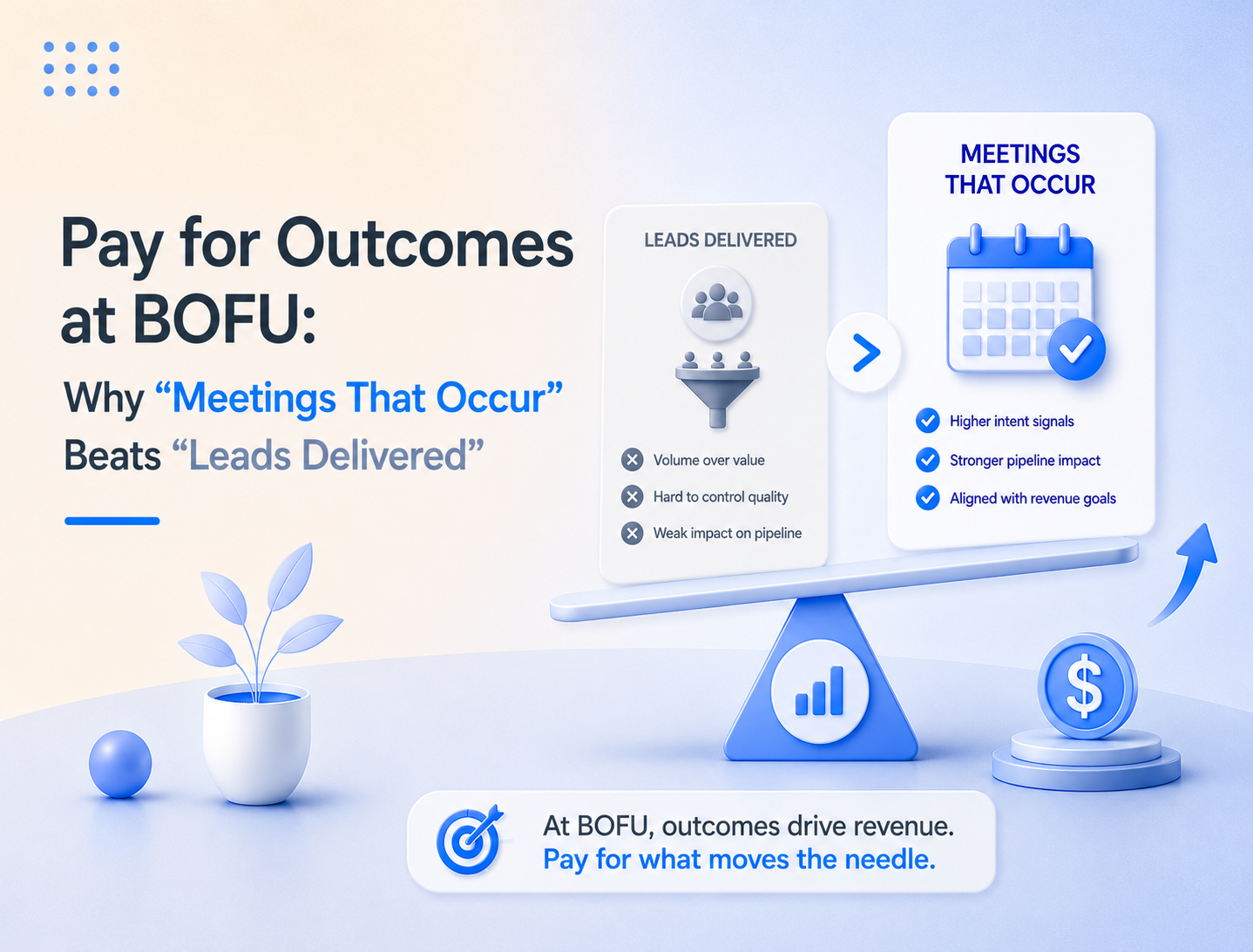
Pay for Outcomes at BOFU: Why “Meetings That Occur” Beats “Leads Delivered”
Demand Generation


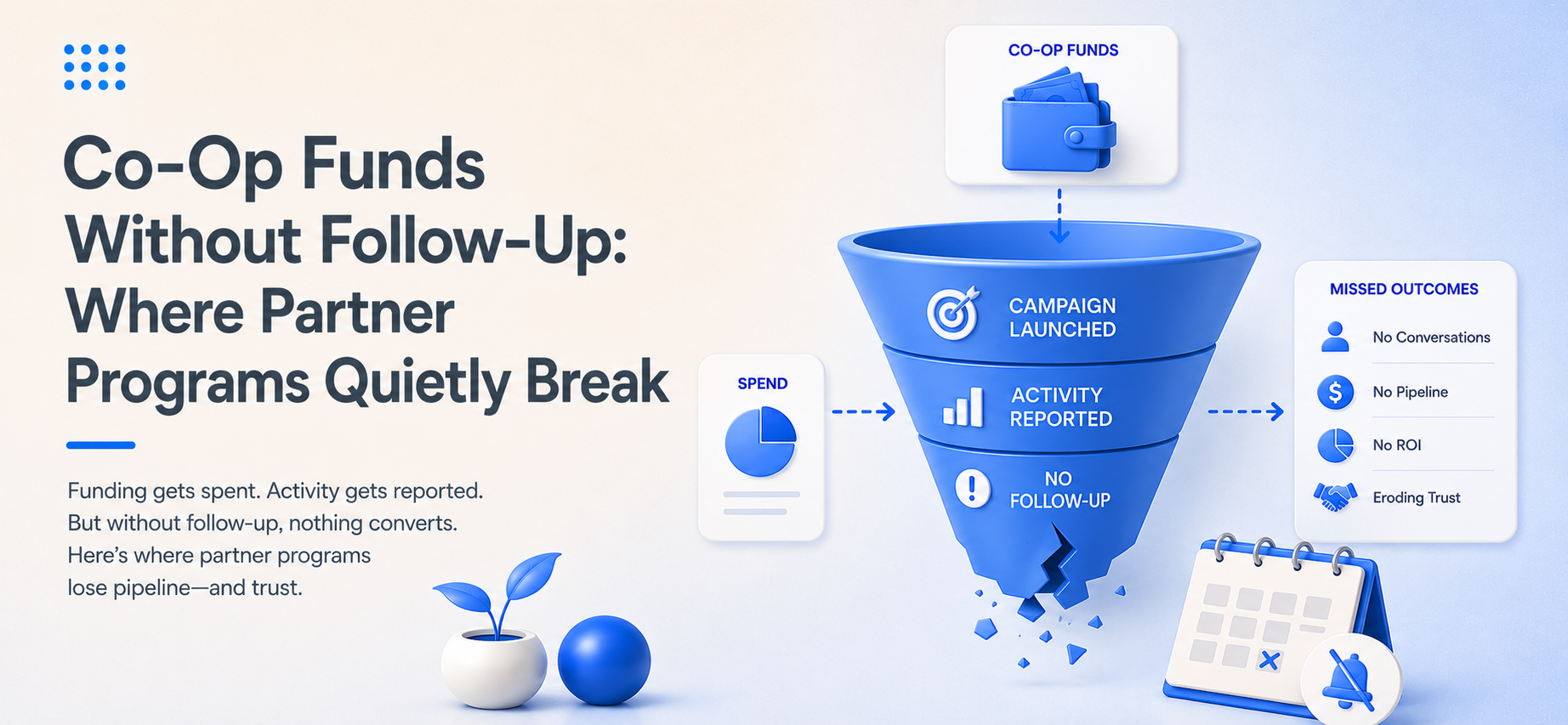
Co-Op Funds don’t fail at the campaign—they fail at follow-up. Learn where partner programs quietly break after leads come in, and how enterprise demand gen teams convert partner engagement into Director+ meetings that occur with clear ownership, faster response, and higher-quality qualification.
-
Channel & Partner Marketing
Introduction
Co-Op Funds should be one of the easiest budgets in B2B: align with partners, run campaigns, generate demand, and share attribution.
But in enterprise channel motions, the thing that breaks most often isn’t the campaign.
It’s the follow-up.
A partner webinar can hit its registration goal and still produce zero pipeline. A co-branded offer can drive “leads” and still get ignored by sales. And a polished quarterly plan can still end with the most painful sentence in partner marketing:
“We executed… but nothing progressed.”
If Co-Op Funds are meant to create revenue impact, follow-up can’t be an afterthought. It has to be the design constraint.
This post shows where partner programs quietly break after the lead comes in—and how demand gen, partner, and channel teams can operationalize follow-up in a way that produces Director+ meetings that occur (and actually move to a next step).
What Co-Op Funds Means for Demand Generation Marketers and other titles that meet Site Ascend’s ICP
In 2026, Co-Op Funds aren’t “campaign money.” They’re a shared bet between you and your partners that says:
We can turn joint market presence into real sales conversations.
That changes what “success” looks like. A modern Co-Op motion needs to prove three things:
If you can’t consistently answer those three, you don’t have a Co-Op engine—you have a Co-Op calendar.
Common Challenges Marketers Face
The follow-up breakdown is usually a chain of small problems that compound. Here are the most common failure points.
The “handoff gap” (partner lead ≠ sales-ready lead)
Partner leads arrive without enough context for sales to act confidently. Even strong account fit can stall if the lead record doesn’t explain:
Sales doesn’t ignore leads because they don’t want pipeline. They ignore leads because the lead doesn’t feel like a path.
Speed kills (or, process lag kills)
In enterprise, momentum is fragile. A day or two of delay can turn “interested” into “busy,” and “busy” into “gone.”
Co-Op Funds are often planned like marketing programs, but they need to be run like revenue operations:
Shared ownership becomes no ownership
Partner marketing thinks sales will follow up. Sales thinks the partner will. The partner thinks marketing has an SDR motion.
Everyone is reasonable. The lead still sits.
Seniority drift
Co-Op programs naturally create volume, and volume creates temptation: accept any engagement as a win.
But enterprise progression depends on Director+ involvement early enough to sponsor next steps. When follow-up chases “any meeting,” you get calendar noise and sales skepticism.
Reporting that proves activity, not outcomes
It’s easy to report:
It’s harder (and more valuable) to report:
When the dashboard can’t speak sales’ language, Co-Op Funds get judged as “soft” spend—even if the top of funnel looks healthy.



.png)

%201.png)


.png)


Solutions That Work
Fixing follow-up isn’t about adding more steps. It’s about installing a repeatable operating system that turns partner engagement into real conversations.
Make “meetings that occur” the Co-Op output
Co-Op Funds work best when you define success as a concrete, auditable outcome—especially one your sales org trusts.
Site Ascend’s approach aligns to this standard by charging only for meetings that occur. That shifts incentives in a way most Co-Op programs need:
Protect partner relationships with white-labeled outreach
Channel programs can’t feel chaotic to the buyer. When multiple brands and multiple reps reach out in different voices, the buyer disengages—or the partner relationship gets strained.
Site Ascend supports Co-Op execution with white-labeled outreach through Channel Marketing. You get a consistent motion that preserves partner credibility while still driving measurable meetings.
Build follow-up around Director+ targeting, not volume
The fastest way to improve Co-Op ROI isn’t “more leads.” It’s fewer leads with higher progression probability.
Site Ascend targets Director-level and above only meetings. That helps enterprise teams avoid the classic pattern:
Use real-time visibility to manage the program (not just report on it)
Follow-up needs a live feedback loop. If a segment isn’t connecting, you should know now—not after a quarterly wrap-up.
Site Ascend provides a real-time reporting dashboard so channel and demand gen leaders can spot friction quickly:
When Co-Op is content-led, add lead qualification before “meeting ask”
Many partner programs start with an opt-in moment: a download, a webinar registration, a partner referral, a booth scan.
That opt-in is not a meeting request. Treating it like one creates awkward calls and low conversion.
A better approach is a short qualification motion that clarifies:
Site Ascend supports this kind of conversion layer via Lead Qualification (converting opt-ins into qualified sales meetings), which is often the missing bridge between Co-Op activity and sales outcomes.
Actionable Steps for Marketers
Here’s a practical checklist to tighten follow-up without turning your program into process theater.
The Co-Op follow-up playbook (enterprise-ready)
Define a single “source of truth” outcome
Assign real ownership
Set response expectations
Qualify before you pitch a meeting
Hold the line on seniority
Instrument the program like revenue
Comparison of Market Solutions
Most Co-Op teams use one of a few execution models. Each can “run programs,” but they don’t all fix follow-up.
In-house follow-up through SDR/BDR teams
This can work well when SDR capacity is stable, routing is tight, and partner follow-up is truly prioritized.
The problem is reality: SDR teams are usually measured across many motions at once. Partner leads often land as “important, but later.” Even a great Co-Op program can underperform if it’s competing with inbound, outbound sequences, events, and internal SLAs.
Partner-led follow-up
In some ecosystems, partners are strong at following up and driving meetings—especially when the partner’s sales motion is mature and tightly aligned to yours.
More often, partner-led follow-up introduces inconsistency:
When follow-up varies partner to partner, your Co-Op ROI will vary too.
Outsourced execution optimized for activity
Some outsourced options move fast and generate volume. But when the model is paid on effort or booked meetings (not held meetings), quality and attendance can become secondary.
That’s where programs quietly break: the report looks busy, sales experience feels messy, and the next quarter’s budget gets harder to defend.
Performance-aligned follow-up built for Director+ meetings
A more reliable model ties incentives to outcomes and protects brand consistency:
That’s the lane Site Ascend operates in—especially for enterprise teams trying to turn Co-Op into repeatable pipeline, not periodic activity.
Conclusion
Co-Op Funds don’t fail because partners don’t work. They fail because the hardest part—follow-up—gets treated like a downstream detail instead of the core system.
If you want Co-Op that produces pipeline you can defend, build around:
If you’re ready to turn Co-Op Funds into partner-sourced pipeline you can defend, start a pilot with Site Ascend and measure success the way sales does: Director+ meetings that occur.
What’s the #1 reason Co-Op Funds don’t turn into pipeline?

How do we avoid channel conflict when following up on partner leads?
What should we measure if we want sales to take Co-Op seriously?


Start your pilot campaign today and explore the full range of Site Ascend's demand generation capabilities. Experience firsthand how we can enhance your efficiency, streamline your processes, and drive growth.
RELATED