Account-Based Marketing (ABM) in 2025: The New Rules for Reaching Director-Level Decision Makers
Account-Based Marketing


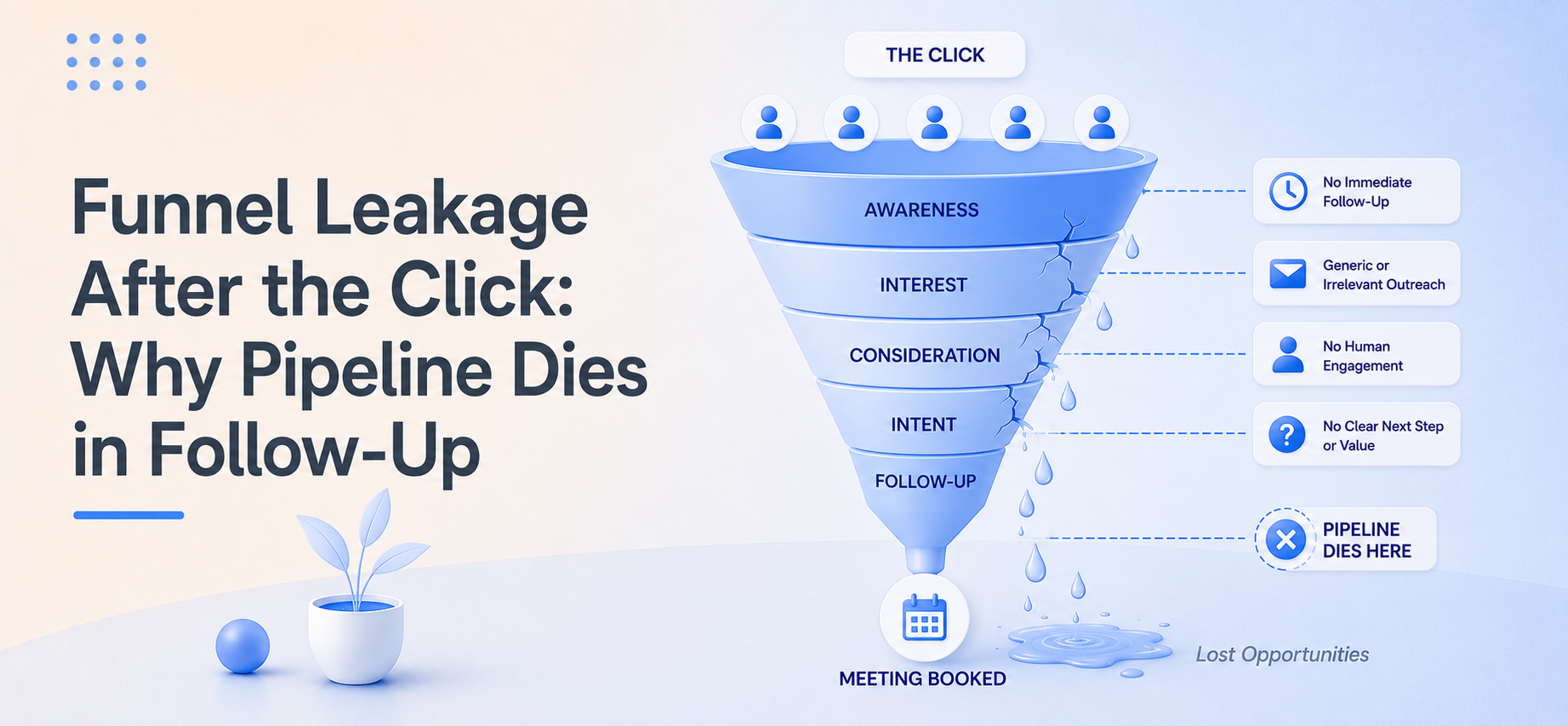
Most funnel leakage doesn’t happen at the top—it happens after the click, when speed drops, ownership gets unclear, and “good
-
Demand Generation
Introduction
Most demand gen teams don’t have a “lead problem.” They have a follow-up problem.
You can spend months improving targeting, refining creative, tightening forms, and dialing in routing rules—then watch pipeline stall because the next step doesn’t happen fast enough, clearly enough, or consistently enough. The leak isn’t always visible in your dashboards, either. It shows up weeks later as:
This is the part of the funnel that kills revenue outcomes quietly: the space between interest and a meeting.
If you’re accountable for pipeline, the fix isn’t “more leads.” It’s a stronger conversion system after the click—one built to produce meetings that occur, not just leads delivered.
What Funnel Leakage Means for Demand Generation Marketers and Similar Roles
Funnel leakage is the measurable (and often unmeasured) drop-off that happens after a prospect signals interest—but before a sales conversation happens.
In practical demand gen terms, funnel leakage is what happens when:
The reason it matters is simple: pipeline isn’t created by interest. Pipeline is created by conversations.
When follow-up fails, you’re not just losing leads—you’re losing:
Common Challenges Marketers Face
Funnel leakage happens for predictable reasons. Most teams recognize these symptoms—even if they’re buried across systems.
1) “Fast follow-up” is a myth in enterprise motion
Enterprise leads don’t convert because you sent one email in 5 minutes. They convert because someone persistent, credible, and aligned to the right persona connected the dots and earned the next step.
The reality: SDR teams are overloaded, priorities shift daily, and many leads never receive a real attempt beyond automation.
2) Sales and marketing define “qualified” differently
Marketing measures engagement. Sales measures conversion.
If your lead definition is based on activity (downloads, page views, event registrations), sales will often call them “unqualified” because there’s no immediate business reason to meet.
3) Leads arrive incomplete or misrouted
Bad data creates delays. Delays kill conversion.
If the account, persona, segment, or ownership isn’t clear, the lead sits. Or it gets routed to the wrong rep. Or it gets passed to a partner who doesn’t follow up at all.
4) The handoff is too passive
In many orgs, the “handoff” is simply a record in CRM.
There’s no confirmed time, no commitment, and no accountability. A lead becomes a task—then becomes a backlog.
5) Events create a second leak: registration → attendance
Event marketing is especially vulnerable. Even when you drive registrations, the biggest leakage happens in the days leading up to the event.
Most teams don’t have a high-touch confirmation workflow that includes:



.png)

%201.png)


.png)


Solutions That Work
To stop funnel leakage, you need to treat the post-click workflow as a conversion engine—not a set of tasks.
This is where Site Ascend is designed to operate: turning interest into booked meetings, using consistent outreach execution and pay-for-performance accountability.
Executive Meetings: Convert priority accounts into scheduled conversations
For enterprise pipeline, the “conversion event” is not a lead status—it’s a scheduled meeting with a decision-maker.
Site Ascend’s Executive Meetings program focuses on:
This directly addresses leakage caused by low follow-up capacity, misalignment on qualification, and weak conversion mechanics.
Lead Qualification: Turn opt-ins into sales-accepted meetings
If your inbound engine generates opt-in leads (whitepaper downloads, webinar registrants, demo requests that aren’t ready), the leakage is often in interpretation: what does the signal actually mean, and what is the next step?
Site Ascend’s Lead Qualification is built to:
That reduces sales friction because you are not dumping volume—you’re delivering conversations.
Channel Marketing: White-labeled follow-up on partner campaigns
Partner-sourced leads are one of the highest-leakage channels in enterprise demand gen. The reason is structural: ownership is unclear and follow-up is inconsistent.
Site Ascend’s Channel Marketing program supports:
This reduces leakage without creating channel conflict—and helps MDF actually produce outcomes.
Event Marketing: Fix the registration → attendance → conversation gap
Most teams focus on driving registrants. The real challenge is turning registrants into attendees, and attendees into follow-up.
Site Ascend focuses on:
This is where a meaningful portion of event leakage can be recovered.
Actionable Steps for Marketers
Use this checklist to diagnose where your funnel is leaking and what to fix first.
Funnel Leakage Checklist: Post-Click Conversion
1) Define the conversion event clearly
If your goal is pipeline, your “win” is a meeting—not a status update.
2) Set an outreach SLA that’s realistic for enterprise
Not “respond in 5 minutes.” Instead: multiple touches across channels with a consistent message and persona alignment.
3) Build a qualification rubric sales will accept
Define what qualifies someone for a meeting, including role, account fit, and confirmed intent.
4) Validate data before outreach begins
Bad phone numbers and generic inboxes create silent leakage.
5) Add a confirmation workflow for high-intent actions
Events, partner leads, high-value inbound conversions should trigger a higher-touch motion.
6) Stop handing off “leads.” Start handing off meetings.
This is the biggest structural fix. If you pay for outcomes, you design the workflow around outcomes.
Comparison of Market Solutions
Example 1: The Procurement View
Enterprise marketers are effectively “procuring” pipeline outcomes. The question is which model reduces risk and increases predictability.
Procurement outcome #1: Reduce performance risk
Procurement outcome #2: Reduce brand and relationship risk
Procurement outcome #3: Improve auditability and operational control
In short: most solutions optimize for activity. Site Ascend is built to optimize for outcomes.
Conclusion
Funnel leakage isn’t just a conversion issue—it’s a pipeline reliability issue. If your post-click motion depends on overloaded SDR teams, unclear ownership, or inconsistent follow-up, you’ll keep buying demand and watching it evaporate before it becomes a conversation.
The fix is a system that treats follow-up like a revenue motion: qualify properly, execute outreach consistently, and measure success in meetings that occur—not leads delivered.
If you want to reduce funnel leakage and turn more of your existing demand into real pipeline, Site Ascend can help you pilot a pay-for-performance program built to convert interest into booked meetings.
What’s the biggest cause of funnel leakage in enterprise demand gen?

How do you reduce leakage without overwhelming SDRs?
How do you know if your leads are good but your follow-up is failing?


Start your pilot campaign today and explore the full range of Site Ascend's demand generation capabilities. Experience firsthand how we can enhance your efficiency, streamline your processes, and drive growth.
RELATED