Outbound Marketing in 2026: What Still Works, What Doesn’t, and Why
Outbound Marketing


Generating qualified leads is only half the battle. Learn how lead leakage silently erodes pipeline, where revenue opportunities are lost, and the operational strategies marketing leaders can use to convert more qualified prospects into sales pipeline.
-
Pipeline Generation
Introduction
Every demand generation leader has faced the same frustrating scenario: marketing delivers a healthy volume of qualified leads, dashboards show strong top-of-funnel performance, yet pipeline creation consistently falls short of expectations. The instinct is often to invest in more campaigns, acquire more leads, or increase media spend. In reality, the problem may not be lead generation at all.
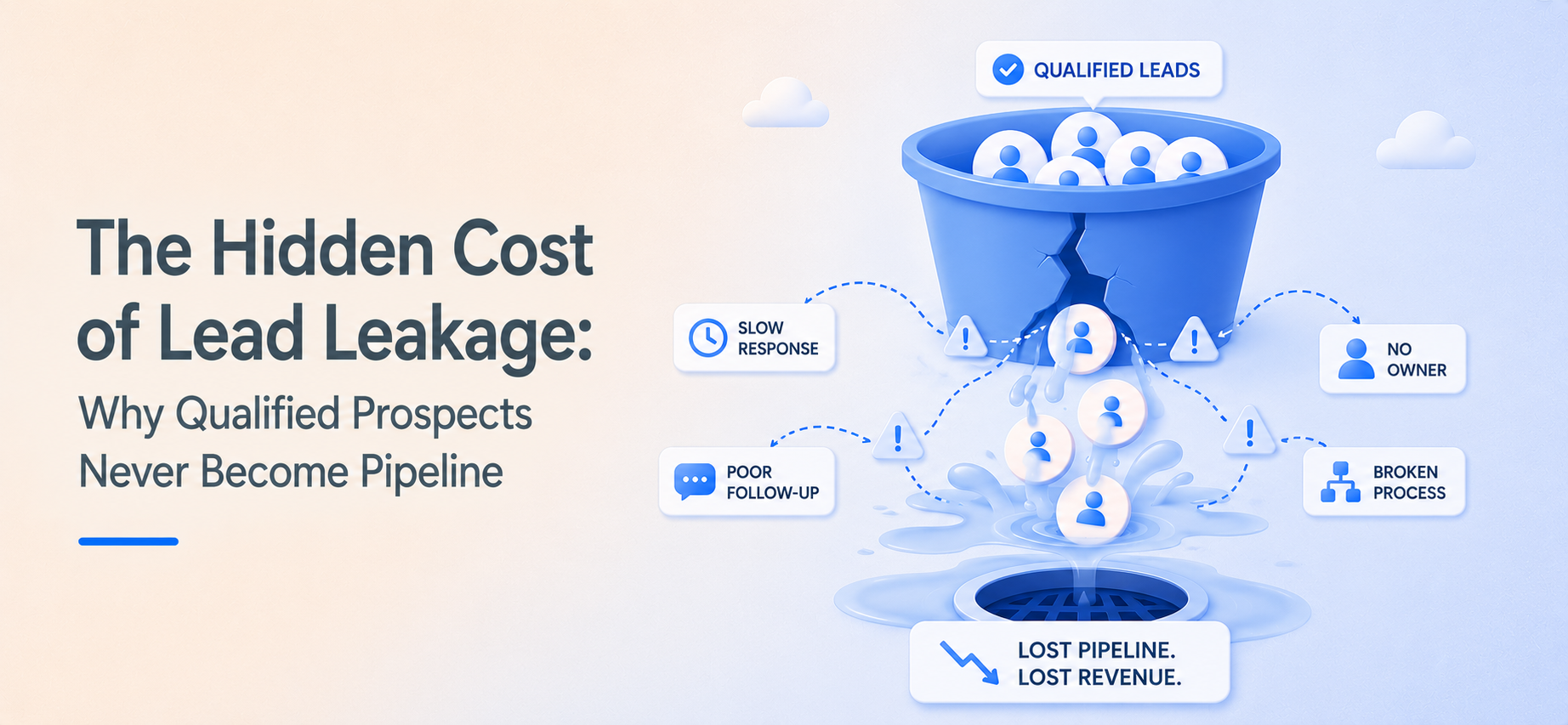
Lead leakage—the gradual loss of qualified prospects as they move through the revenue funnel—is one of the most overlooked causes of underperforming pipeline. It rarely appears as a single failure. Instead, it accumulates through delayed follow-up, inconsistent qualification, unclear ownership, poor routing, disconnected systems, and weak sales and marketing alignment.
For B2B technology organizations, even small amounts of leakage can significantly impact pipeline velocity, forecast accuracy, and revenue attainment. The organizations that consistently outperform their peers are not necessarily generating more leads—they are preserving more of the buying intent they already create.
This article explores why lead leakage occurs, where it hides within modern demand generation programs, and what marketing leaders can do to reduce revenue loss before prospects disappear from the funnel.
What Lead Leakage Means for Demand Generation Marketers
Lead leakage refers to the loss of qualified opportunities before they become active sales pipeline. Unlike lead quality issues, lead leakage affects prospects who have already demonstrated legitimate buying signals but fail to progress because of process, communication, or operational breakdowns.
For demand generation leaders, lead leakage often appears as:
In many organizations, leakage isn't caused by one department. Marketing, sales, marketing operations, partner teams, and business development all influence whether qualified buyers continue progressing or quietly exit the buying journey.
Understanding where leakage occurs is the first step toward improving pipeline efficiency.
Common Challenges Marketers Face
Lead leakage rarely stems from a lack of marketing activity. More often, it reflects operational friction between teams and systems.
Delayed Response Times
Prospects who request information or demonstrate buying intent expect timely engagement. Even qualified buyers may move on when follow-up is inconsistent.
Inconsistent Qualification Standards
Marketing and sales frequently operate with different definitions of readiness. Without shared qualification criteria, valuable prospects may be overlooked or recycled unnecessarily.
Fragmented Ownership
As leads move between marketing, SDRs, account executives, partner teams, or regional sales organizations, accountability often becomes unclear.
Limited Visibility
Marketing teams frequently measure lead generation while sales measures pipeline creation. Without shared visibility, identifying leakage becomes difficult.
Operational Complexity
As organizations expand into partner programs, field marketing, executive meeting campaigns, and event marketing, the number of transition points increases—creating additional opportunities for leakage.



.png)

%201.png)


.png)


Solutions That Work
Reducing lead leakage requires improving how prospects move through the revenue engine—not simply generating more demand.
1. Map the Complete Lead Journey
Many organizations optimize individual stages without understanding the full buyer journey. Mapping every transition—from inquiry through opportunity creation—helps identify where qualified prospects disappear.
Evaluate:
Visibility often reveals larger issues than additional lead generation ever could.
2. Standardize Qualification Criteria
Organizations with shared qualification frameworks consistently experience higher sales acceptance rates.
Rather than relying solely on scoring models, define objective qualification standards that both marketing and sales agree upon.
These standards should include:
Consistency reduces ambiguity and prevents qualified buyers from falling through operational gaps.
3. Measure Pipeline Preservation—Not Just Pipeline Creation
High-performing demand generation teams increasingly monitor "pipeline preservation" metrics alongside traditional funnel metrics.
Examples include:
Monitoring these indicators surfaces hidden revenue risks long before pipeline declines become visible.
4. Create Cross-Functional Accountability
Lead leakage is rarely a marketing problem or a sales problem—it is a revenue operations problem.
Establish shared KPIs, recurring pipeline reviews, and agreed-upon service levels that encourage collaboration instead of finger-pointing.
Marketing, SDRs, sales leadership, partner teams, and operations should collectively own funnel performance.
Where Site Ascend Fits
Once an organization has established effective qualification standards and operational processes, execution becomes the next challenge.
Site Ascend helps technology companies operationalize these best practices by supporting qualified executive meetings, lead qualification programs, channel marketing initiatives, and event registration campaigns. Rather than replacing internal teams, Site Ascend extends their capacity with U.S.-based outreach, director-level targeting, performance-based engagement models, and real-time reporting that help marketing organizations convert more qualified buying interest into meaningful sales conversations.
Actionable Steps for Marketers
The Lead Leakage Readiness Assessment
Use the following assessment to identify where your organization is most vulnerable.
Process
Visibility
Execution
Continuous Improvement
Organizations answering "No" to multiple questions likely have greater opportunity to improve pipeline through operational excellence than through increased lead acquisition.
Comparison of Market Solutions
Organizations typically address lead leakage through several approaches.
Internal teams offer strong organizational knowledge but may struggle with bandwidth during campaign spikes or large event initiatives.
Traditional outsourced providers can increase capacity, though qualification consistency and executive engagement quality vary significantly between providers.
Offshore models often improve cost efficiency but may present challenges when engaging senior decision-makers or representing enterprise brands.
Technology platforms automate routing and workflows but depend on well-defined operational processes and disciplined execution.
Performance-based execution partners combine process support with measurable outcomes, helping organizations improve qualification consistency while maintaining visibility into pipeline performance.
The right approach depends on organizational maturity, internal resources, sales complexity, and revenue objectives.
Conclusion
Lead leakage is one of the most preventable sources of lost pipeline in B2B demand generation. Organizations that focus exclusively on generating more leads often overlook the operational inefficiencies that quietly erode revenue before sales conversations even begin.
By improving qualification standards, increasing visibility across the buyer journey, strengthening cross-functional accountability, and measuring pipeline preservation alongside pipeline creation, marketing leaders can significantly increase the return on every qualified lead they generate.
For organizations looking to operationalize these strategies at scale, Site Ascend provides execution support through executive meetings, lead qualification, channel marketing, and event marketing programs that help convert qualified interest into qualified sales conversations.
If you're ready to reduce lead leakage and improve pipeline quality, contact Site Ascend or start a pilot program.
How is lead leakage different from poor lead quality?

Can technology alone eliminate lead leakage?
Which metric best indicates lead leakage?


Start your pilot campaign today and explore the full range of Site Ascend's demand generation capabilities. Experience firsthand how we can enhance your efficiency, streamline your processes, and drive growth.
RELATED