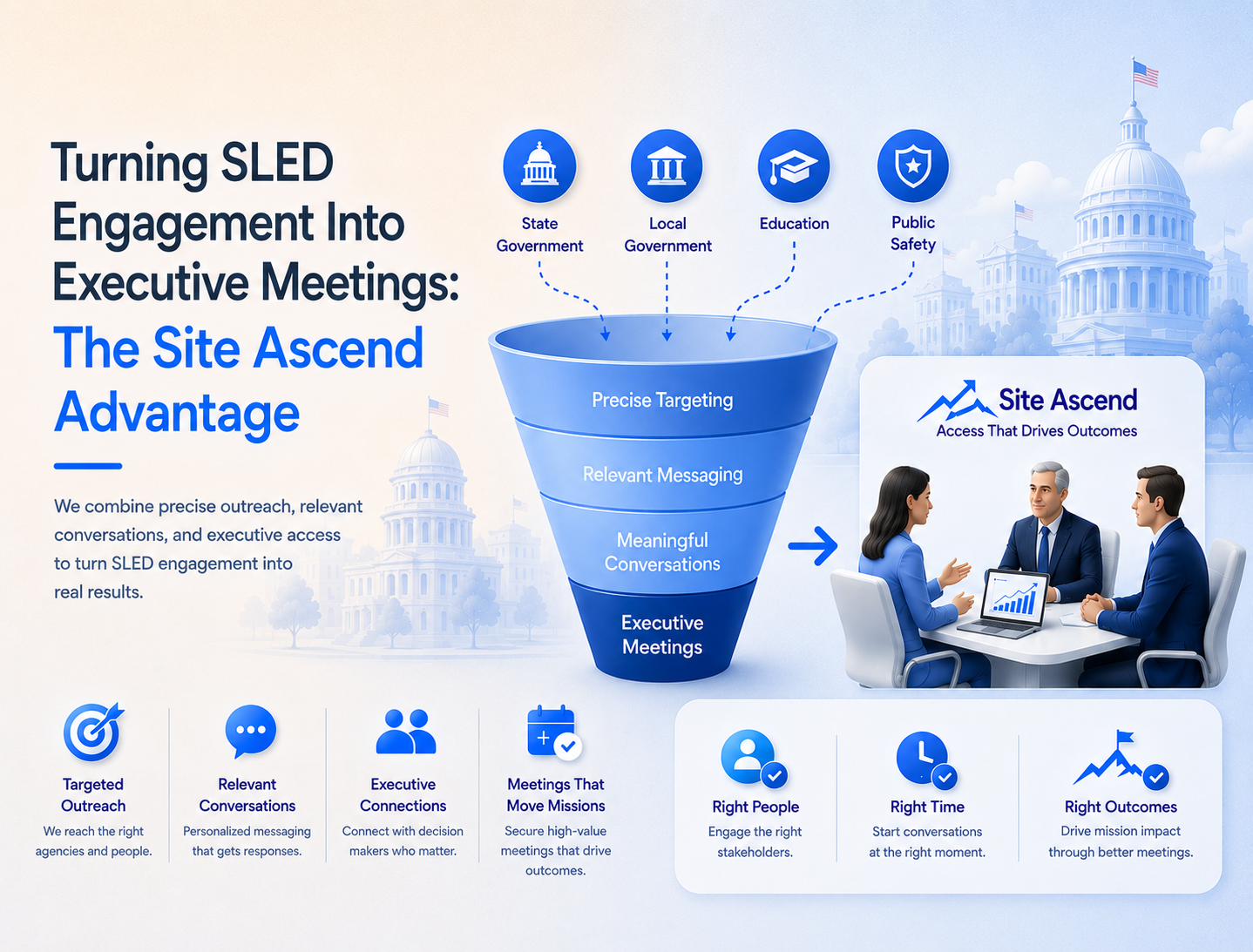
Turning SLED Engagement Into Executive Meetings: The Site Ascend Advantage
Public Sector Demand Generation


Data enrichment should reduce lead risk—not just fill fields. Here’s how enterprise teams turn cleaner records into sales-accepted meetings that actually occur.
-
Demand Generation
Introduction
Most B2B demand gen teams treat data enrichment like housekeeping: append a few missing fields, sync the record, move on. The problem is that “clean” is not the same thing as convertible. A lead can be perfectly formatted and still be unusable for sales—wrong contact, wrong role, wrong account, wrong timing, or no clear next step.
In 2026, enrichment only matters if it reduces lead risk and increases sales-accepted next steps. That means enriching for action: the information your team needs to route, prioritize, and book real conversations—fast—without burning SDR time or creating channel conflict.
This is where Site Ascend’s model fits naturally. We don’t optimize for activity. We optimize for outcomes: qualified meetings that occur, with director-level and above contacts, supported by real-time reporting and U.S.-based outreach.
What Data Enrichment Means for Demand Generation Marketers (and Site Ascend’s ICP)
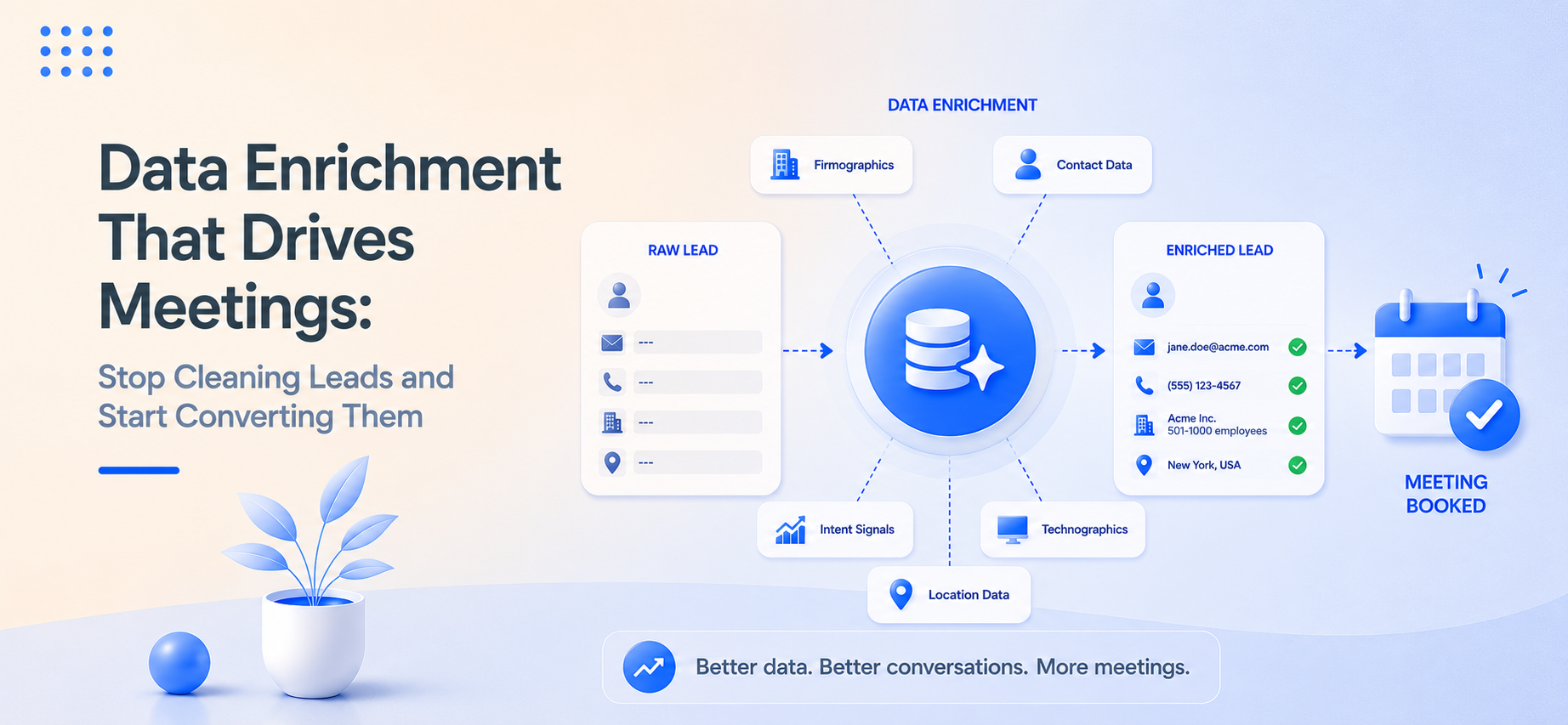
Data enrichment is the process of enhancing a lead or account record with additional attributes—firmographics, role details, contactability, buying context, and routing signals—so it can move through your revenue process with minimal friction.
For demand gen and revenue marketing leaders, enrichment should answer three operational questions:
When enrichment is done well, it’s not a “data project.” It’s a conversion accelerator. It shortens time-to-first-touch, reduces misroutes, and prevents the most common enterprise failure mode: high-volume lead capture with low-confidence follow-up.
Common Challenges Marketers Face
Even mature teams struggle with enrichment because the issue usually isn’t missing data—it’s missing decision-grade data.
1) Enrichment optimizes for completeness, not conversion
A record can have a full address, industry code, and employee count—and still have no insight into whether the contact is the right persona or reachable.
2) Sales acceptance collapses when the data doesn’t support a next step
If enrichment doesn’t clarify role relevance, account fit, and what to do next, sales will “accept” a lead in the CRM and then ignore it in reality.
3) Event and channel leads arrive with weak ownership rules
Partner- and event-sourced leads often create internal friction: Who owns follow-up? What’s the SLA? What qualifies as “worked”? Without enriched routing signals, the lead stalls.
4) SDR time gets burned validating what marketing could have validated earlier
If SDRs are spending cycles fixing titles, hunting direct dials, or figuring out which rep should own the account, your enrichment layer is functioning as a tax—not leverage.
5) Reporting becomes noise
When attribution and dashboards reflect volume rather than outcomes, marketing can’t defend spend—especially for events and partner plays—because the data doesn’t connect to meetings that actually happened.



.png)

%201.png)


.png)


Solutions That Work
The upgrade is straightforward: enrich for routing + readiness, then pair enrichment with an execution path that turns “interest” into “next steps.”
1) Use enrichment to create an “actionable lead” standard
Instead of chasing 100% field completion, define a minimum dataset that makes a lead operationally usable:
Site Ascend operationalizes this standard by focusing outreach on director-level and above and executing through a U.S.-based contact center—so “contactability” is real, not assumed.
2) Turn enrichment into a qualification path, not a dead-end
Enrichment without follow-through still leaves you with a better spreadsheet and the same pipeline problem. The fix is to link enriched leads to a defined conversion path:
This is the practical advantage of Site Ascend’s model: your enriched leads don’t just sit—they get worked into meetings that occur.
3) Reduce lead risk with pay-for-outcome execution
Most enrichment programs are built to improve internal confidence. But pipeline is built when external behavior changes—when the buyer actually shows up to a conversation.
Site Ascend’s “only pay for meetings that occur” structure is a built-in risk reducer. It forces the system to optimize for the most important metric: a real meeting on the calendar that is attended—not just a handoff, not just an MQL, not just a reply.
4) Make reporting useful by anchoring it to outcomes
If your enrichment layer is designed for conversion, reporting stops being a vanity dashboard and becomes an operational cockpit:
Site Ascend’s real-time reporting closes the loop quickly enough to adjust targeting and messaging while the campaign is still running.
Actionable Steps for Marketers
Use this checklist to shift enrichment from “cleanup” to “conversion.”
The Conversion-First Enrichment Checklist
If you can’t guarantee fast follow-up internally, run a pilot where Site Ascend works enriched leads into qualified meetings—so your data investment actually turns into pipeline movement.
Comparison of Market Solutions
Most teams solve enrichment and conversion in one of three ways. Each has predictable outcomes.
Example 1: The Procurement View
Outcome 1: Reduce lead risk (waste, misroutes, low acceptance)
Outcome 2: Increase sales acceptance and follow-through
Outcome 3: Prove pipeline impact with defensible reporting
Conclusion
Data enrichment should not be a formatting exercise. It should be a revenue-control layer—one that reduces lead risk, increases sales acceptance, and accelerates the only outcome that matters: next steps that move pipeline forward.
If your team is spending time cleaning leads but still fighting slow follow-up, low acceptance, or stalled event and partner programs, it’s time to upgrade from enrichment to execution.
If you want to see what “conversion-first enrichment” looks like in practice, contact Site Ascend to start a pilot focused on qualified meetings that occur.
What’s the difference between data enrichment and lead qualification?

Why does sales ignore “good” leads even after enrichment?
Which enrichment fields matter most for enterprise demand gen?


Start your pilot campaign today and explore the full range of Site Ascend's demand generation capabilities. Experience firsthand how we can enhance your efficiency, streamline your processes, and drive growth.
RELATED