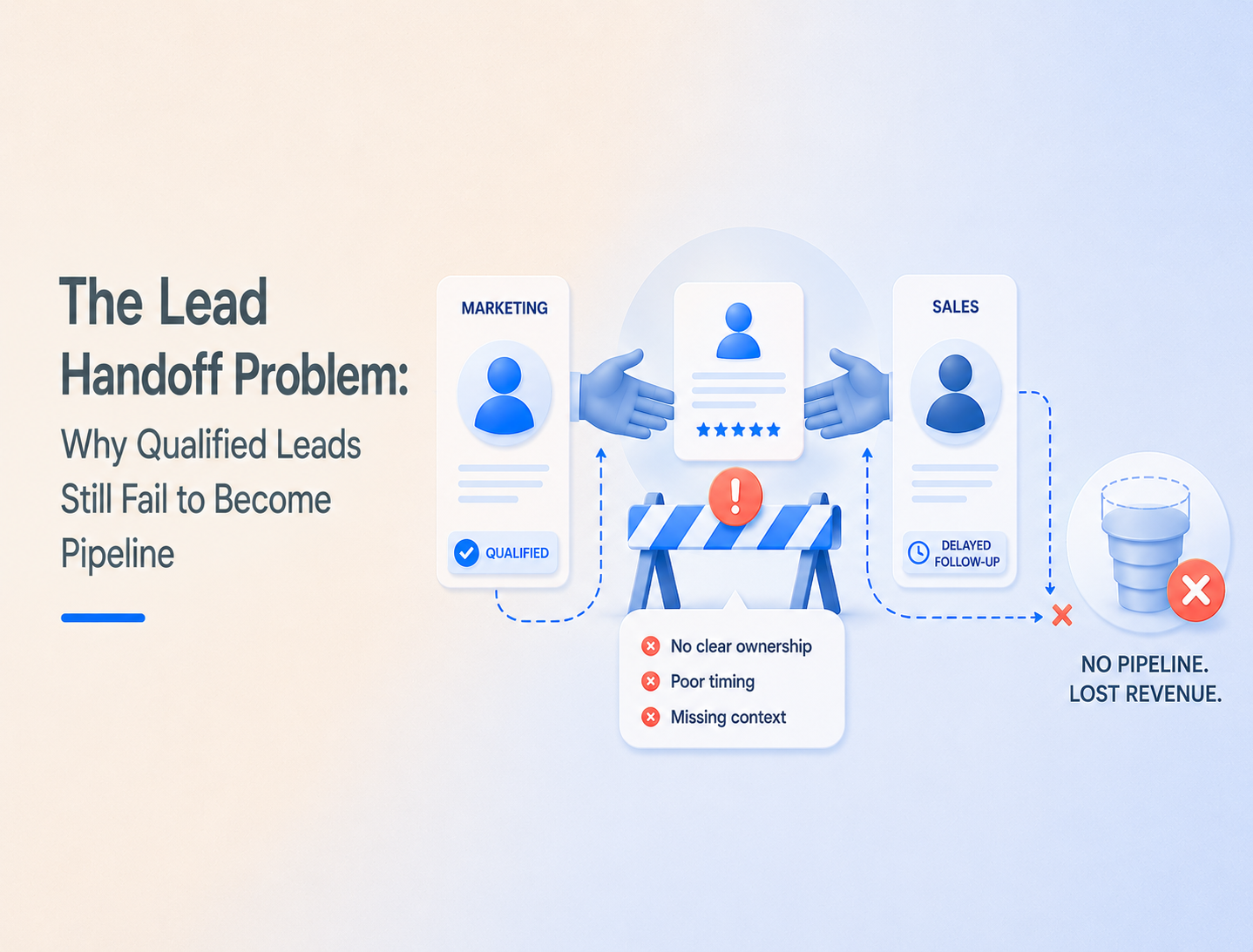
The Lead Handoff Problem: Why Qualified Leads Still Fail to Become Pipeline
Demand Generation


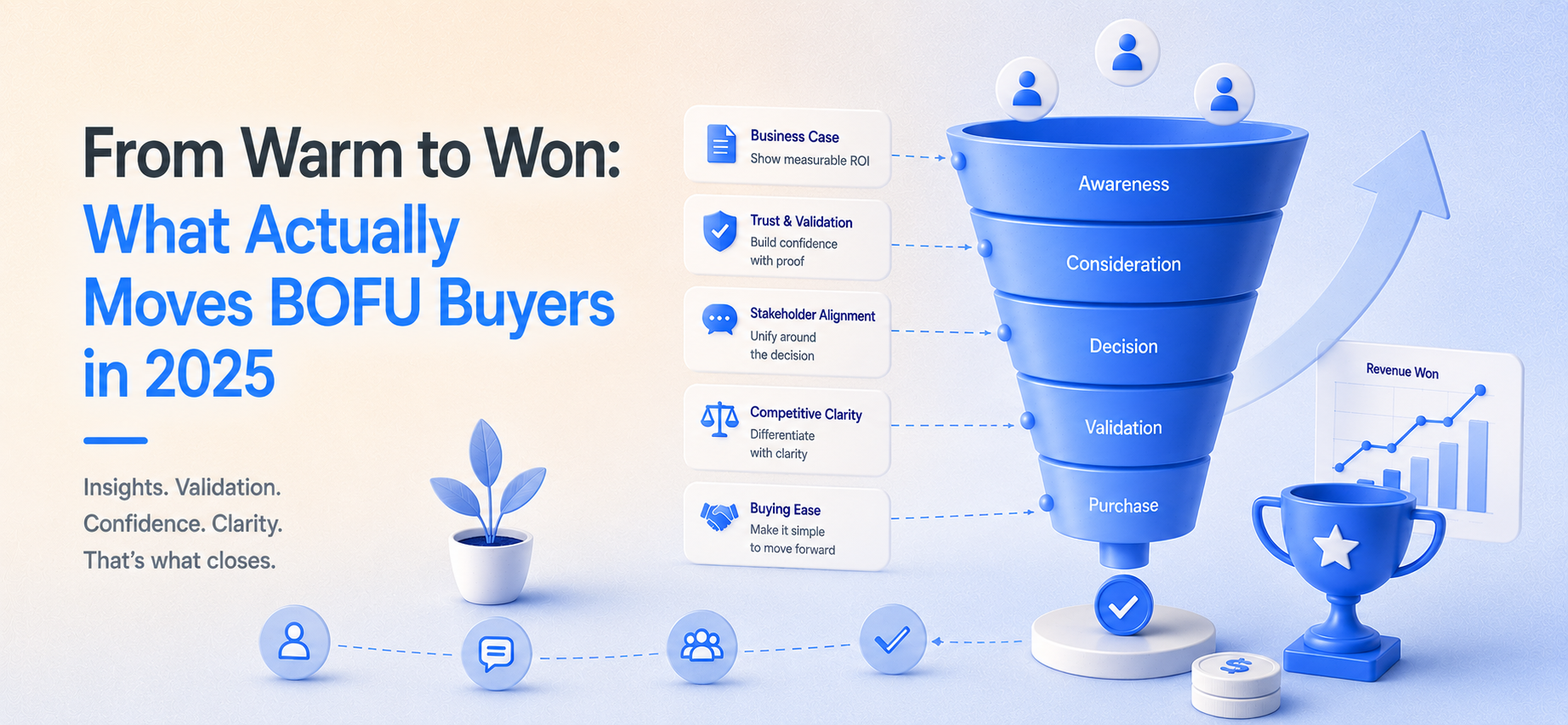
BOFU buyers in 2025 aren’t stalling because interest is low — they’re stalling because follow-through is slow, mis-targeted, or overly automated. Here’s what actually converts warm late-stage intent into director-level meetings and real pipeline momentum.
-
Demand Generation
Introduction
BOFU is supposed to be the easy part.
The leads are warm.
The accounts are known.
The intent is obvious.
Sales is already circling.
And yet… this is where so many B2B tech funnels stall.
Not because buyers aren’t interested — but because late-stage interest gets treated like a finish line instead of what it really is:
A narrow timing window where confidence is fragile, competition is loud, and momentum is everything.
In 2025, BOFU doesn’t reward who has the most “sales-ready” leads.
It rewards who acts on readiness first — with real, credible human engagement that turns evaluation into commitment.
That’s the gap Site Ascend helps demand gen teams close.
Because at the bottom of the funnel, the question isn’t “Do they want to buy?”
It’s “Did we reach the right decision-maker at the right moment, in a way that moved them forward?”
What BOFU (Bottom-of-Funnel) Means for Demand Generation Marketers and other titles that meet Site Ascend’s ICP
BOFU is the conversion zone of your funnel.
It’s where buyers have already done most of the thinking, and now they’re deciding whether to move — or pause.
In tech, BOFU looks like:
Here’s the thing about 2025 BOFU:
“Warm” doesn’t mean “moving.”
Warm means open to moving — if the experience makes the decision feel safe, simple, and timely.
If it doesn’t, even strong late-stage signals fade into limbo.
So BOFU isn’t defined by lead score alone.
It’s defined by what happens when real evaluation meets real follow-through.
Common Challenges Marketers Face
BOFU struggles today for three quiet reasons.
First: timing decay.
Late-stage intent is perishable. An account can be hot on Tuesday and cold by Friday if nobody engages while momentum is high. Buyers don’t always say “no.” They just go silent.
Second: the wrong contact gets the attention.
At BOFU, directors and above are the ones deciding risk, budget, and urgency. If engagement stays trapped at manager or practitioner level, the deal doesn’t advance — even if interest is real.
Third: nurture replaces urgency.
Automated follow-up is great for early stages. BOFU needs something else: credibility, pressure (the good kind), and responsiveness to real questions. Passive sequences feel like stalling to a buyer who’s ready to choose.
The result is a classic BOFU paradox:
Leads pile up.
Intent looks healthy.
Pipeline still doesn’t move.
Not because the funnel is empty — but because the bottom stays passive.



.png)

%201.png)


.png)


Solutions That Work
The demand gen teams winning BOFU in 2025 are doing one important thing differently:
They treat late-stage intent like a live moment that requires real action — not a score that can sit in queue.
That action has three traits:
Speed.
When a BOFU account spikes, response time matters more than almost any other variable. Buyers interpret fast engagement as competence and relevance. Slow engagement feels like a vendor that won’t be reliable after purchase either.
Seniority.
Late-stage follow-through must reach director-level stakeholders early enough to shape the decision. These buyers care less about features and more about outcomes, risk, and internal alignment. If no one engages them directly, momentum dies behind the scenes.
Human qualification.
BOFU isn’t about “more touches.” It’s about the right conversation. You don’t need to blanket a lead with content. You need to know what’s real, what’s blocking motion, and what step gets them to “yes.”
This is where Site Ascend fits into BOFU acceleration.
When buyers show bottom-of-funnel readiness, Site Ascend activates it through onshore, white-labeled outreach that targets director+ decision makers only, and converts that readiness into meetings that actually happen.
Not activity for activity’s sake.
Not leads for volume’s sake.
Just real conversations at the moment timing is hottest, tied to a pay-for-performance model that keeps everyone focused on outcomes.
BOFU doesn’t need more marketing.
It needs a reliable human conversion layer that moves buyers forward.
Actionable Steps for Marketers
If BOFU feels sticky, don’t assume upstream is the issue.
Start by tightening what happens right after late-stage signals show up.
Run a simple BOFU gut-check:
BOFU acceleration isn’t a new channel.
It’s a new behavior.
The teams winning aren’t doing more.
They’re doing BOFU follow-through better and faster.
And they’re not letting readiness wait.
Comparison of Market Solutions
Most tech companies try to solve BOFU with some combination of internal SDR coverage and late-stage nurture.
That works when:
But in reality, BOFU spikes don’t arrive neatly. They surge after events, intent shifts, partner pushes, TOFU conversions, or product moments.
Internal teams often can’t scale quickly enough to catch those windows.
And many outsourced models optimize for activity, not outcomes — leaving buyers with high-touch noise instead of meaningful meetings.
The market is moving toward performance-based human engagement for BOFU because it aligns with what late-stage conversion actually needs:
When your BOFU motion is built on outcomes instead of effort, late-stage readiness turns into pipeline consistently.
Conclusion
BOFU in 2025 isn’t failing because tech buyers aren’t ready.
It’s failing because readiness isn’t being activated fast enough — or at the right level — to become real momentum.
Bottom-of-funnel success today comes down to:
That’s what Site Ascend helps demand gen teams do — with onshore, white-labeled outreach that only charges for meetings that occur.
If your BOFU leads are warm but your deals aren’t moving, it’s time to add a human acceleration layer built for speed and seniority.
Contact Site Ascend to start a pilot and turn BOFU readiness into meetings that close.
Why do BOFU buyers go silent even after strong intent signals?

Is lead scoring enough to prioritize BOFU follow-through?
How does Site Ascend support BOFU conversion?


Start your pilot campaign today and explore the full range of Site Ascend's demand generation capabilities. Experience firsthand how we can enhance your efficiency, streamline your processes, and drive growth.
RELATED