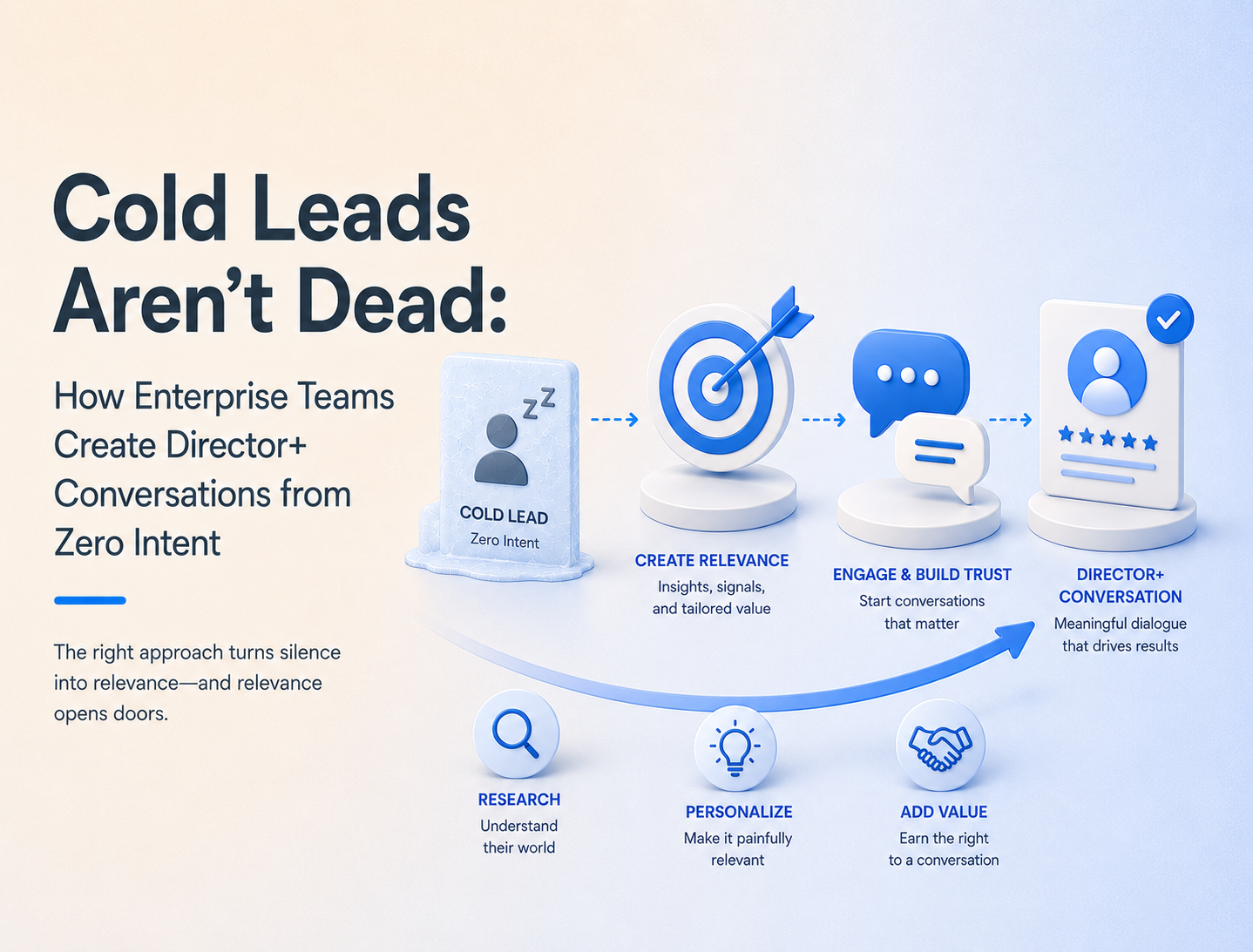
Cold Leads Aren’t Dead: How Enterprise Teams Create Director+ Conversations from Zero Intent
Outbound Strategy


TEMPO (Timing, Environment, Motivation, Process, Outcome) is a practical framework for turning demand gen activity into Director+ meetings that actually happen. Learn how Site Ascend applies TEMPO across executive meetings, event registrant procurement, channel MDF programs, and opt-in lead qualification to improve show rates and meeting quality.
-
Demand Generation
Introduction
Demand gen in B2B tech is full of “successful” programs that still don’t create momentum.
You can hit targets like registrations, MQLs, partner activity, and booked meetings—then watch pipeline stall because the conversations aren’t ready, the stakeholder isn’t senior enough, or the timing isn’t real.
That’s where TEMPO comes in.
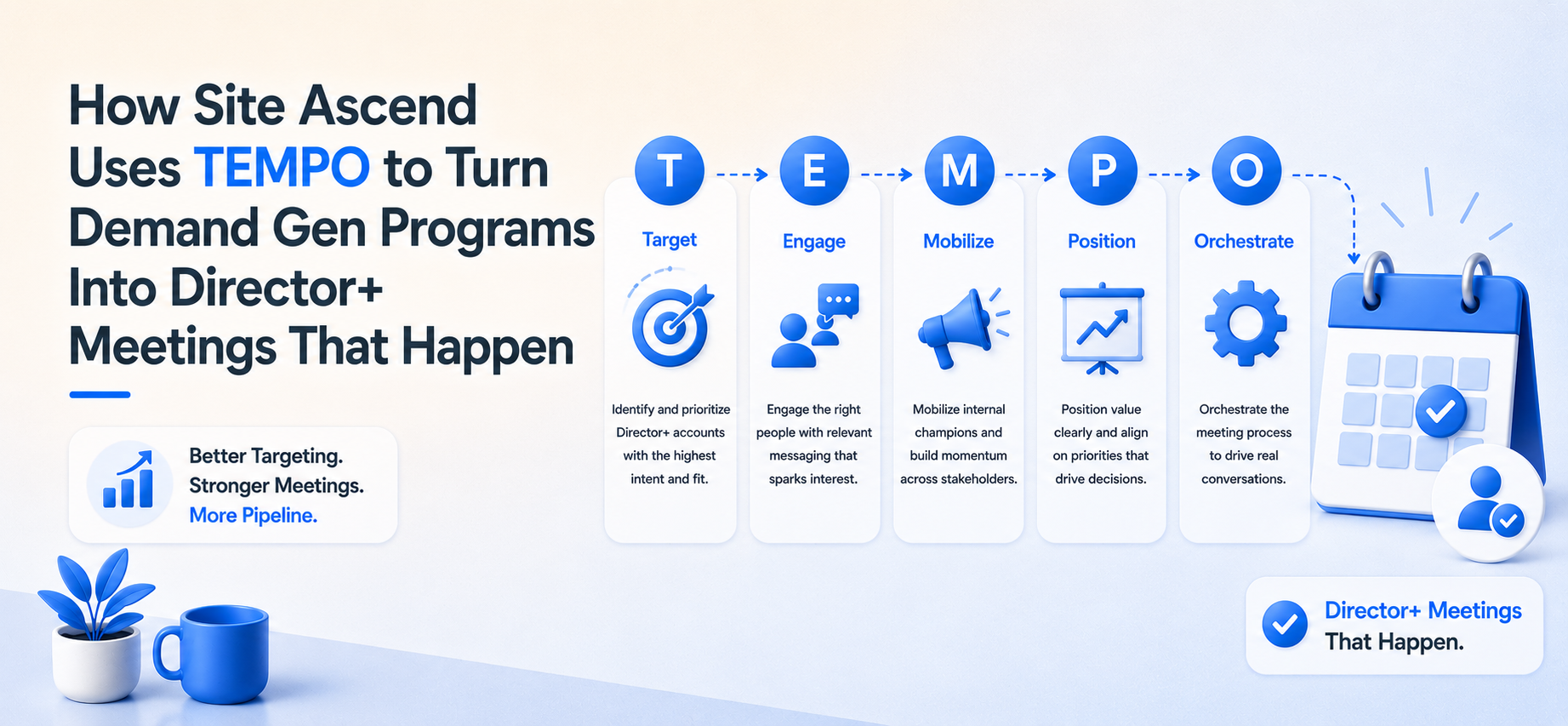
TEMPO (Timing, Environment, Motivation, Process, Outcome) is a practical framework for turning demand gen activity into Director+ meetings that actually occur—and create a clear path to a next step.
What TEMPO means for demand generation marketers (and Site Ascend’s ICP)
TEMPO is a qualification lens—but instead of qualifying leads, it qualifies conversations.
Here’s how demand gen leaders can use it:
If you run events, partner/MDF motions, executive meeting programs, or lead follow-up, TEMPO is how you avoid the classic failure mode: activity without conversion.
Common challenges marketers face
1) Meetings get booked—but don’t happen (or don’t advance)
The most expensive meeting is the one that gets rescheduled twice and dies quietly. This usually happens when:
2) Event ROI gets judged by registrations instead of outcomes
Registrations are easy to count and hard to monetize. When attendee procurement isn’t tightly controlled, you get:
3) MDF gets spent—without a defensible pipeline story
Partner marketing often gets trapped in “proof of activity” (campaigns run, assets used) rather than:
4) Lead follow-up creates friction between marketing and sales
Opt-in leads can be valuable—but if they’re passed without timing, motivation, or process clarity, sales loses trust fast.



.png)

%201.png)


.png)


Solutions that work
Site Ascend’s execution model fits TEMPO because it’s built around quality, attendance, and seniority, not volume.
Below is how TEMPO maps to Site Ascend’s core programs.
Executive Meetings: TEMPO-led conversations with Director+ stakeholders
What it fixes: low-quality meetings, missed attendance, “polite” calls with no next step.
How TEMPO shows up operationally:
Why this works especially well for enterprise teams: Site Ascend targets Director-level and above and aligns incentives with meetings that occur—not “attempts,” “leads,” or “booked time that disappears.”
Event Marketing: TEMPO applied to attendee procurement (not day-of-event services)
What it fixes: event lists that look great on paper but don’t convert.
Important scope clarity: Site Ascend focuses on driving registrants to in-person or digital events via outbound dialing, supported by an SMS workflow up to the event date. It does not provide day-of-event onsite services.
Where TEMPO improves event ROI:
Channel Marketing: TEMPO turns MDF into meetings (white-labeled)
What it fixes: MDF spend that produces activity instead of conversations.
Site Ascend supports partners through white-labeled appointment setting funded by MDF. TEMPO makes this scalable because it standardizes what “ready” looks like:
Lead Qualification: TEMPO as the bridge from opt-in to meeting
What it fixes: opt-ins that overwhelm sales or get ignored.
TEMPO helps separate:
Done well, this converts opt-in activity into sales-ready meetings with context sales can trust.
Actionable steps for marketers
Here’s a TEMPO checklist you can use to improve meeting quality across events, partners, and lead follow-up—without changing your entire strategy.
The TEMPO Meeting-Quality Checklist
Comparison of market solutions
Most teams choose between a few common approaches. Here’s how they typically stack up:
In-house SDR/BDR teams
Best when: you have stable headcount, strong enablement, and consistent territory focus.
Tradeoffs: ramp time, turnover, shifting priorities, inconsistent qualification standards.
TEMPO fit: strong if you can train and enforce it consistently—hard if the team is stretched.
Outsourced appointment setting (volume-first models)
Best when: you need fast coverage and can tolerate variability.
Tradeoffs: incentives often favor quantity (leads/bookings) over meeting quality and attendance; seniority targeting can be inconsistent.
TEMPO fit: depends entirely on whether the provider is accountable to meeting outcomes and context capture.
Partner/MDF programs focused on “activity”
Best when: you need broad awareness and simple reporting.
Tradeoffs: difficult attribution, inconsistent follow-up, and unclear pipeline impact.
TEMPO fit: stronger when MDF is tied to meetings and outcomes, not just campaign outputs.
Full-service event execution (including onsite)
Best when: you need onsite logistics and on-the-ground engagement.
Tradeoffs: can be expensive; doesn’t automatically solve “who attends” or “what happens next.”
TEMPO fit: complementary—but attendee procurement and meeting conversion still need a system.
Where Site Ascend stands out (in TEMPO terms)
Conclusion
TEMPO works because it forces every demand gen motion to answer five questions sales actually cares about:
Why now? What’s true in the account? Who’s motivated? How do decisions happen? What outcome comes next?
If your events, MDF programs, or meeting motions are generating activity without pipeline progression, TEMPO is the framework—and Site Ascend is the execution engine—to turn that activity into Director+ meetings that happen and advance.
If you want to pilot TEMPO with a program designed around meeting outcomes (not volume), contact Site Ascend to explore a pilot for executive meetings, event attendee procurement, channel MDF meeting programs, and/or lead qualification.
Is TEMPO a replacement for lead scoring?

How does TEMPO improve event ROI if the goal is registrations?
What’s the simplest way to pilot TEMPO without rebuilding the team?


Start your pilot campaign today and explore the full range of Site Ascend's demand generation capabilities. Experience firsthand how we can enhance your efficiency, streamline your processes, and drive growth.
RELATED