Why Trade Shows Still Matter in 2025—and How to Actually Drive ROI from Them
Event Marketing


Lead Velocity Rate is one of the clearest signals of real pipeline growth—but only if your team can act on intent fast. Here’s why LVR rises while deals stall in 2025, and how adding a human engagement layer turns accelerating leads into director-level meetings that move revenue.
-
Pipeline Acceleration
Introduction
Most demand gen dashboards in 2025 look healthier than the pipeline feels.
Website traffic is steady. Content is converting. Events are “well attended.” MQL volume might even be up quarter over quarter. And yet… revenue targets still feel like a wrestling match, sales is still asking for “better leads,” and deal velocity isn’t keeping pace with board expectations.
That’s the gap Lead Velocity Rate (LVR) was built to expose.
LVR is one of the few metrics that tells you whether your top-of-funnel growth is actually compounding into future pipeline—or just piling up activity that won’t turn into meetings, opportunities, and closed-won deals. In a market where buyers are harder to reach, cycles are longer, and automation is everywhere, LVR becomes a truth serum.
But here’s the twist: LVR doesn’t fail because it’s a bad metric. It fails when it’s treated as a number to admire instead of a signal to act on.
This post breaks down what LVR really means for modern tech demand gen teams, why it’s the most reliable early indicator of pipeline health, and what to do when your lead growth is outpacing your ability to turn interest into real conversations.
What Lead Velocity Rate (LVR) Means for Demand Generation Marketers and other titles that meet Site Ascend’s ICP
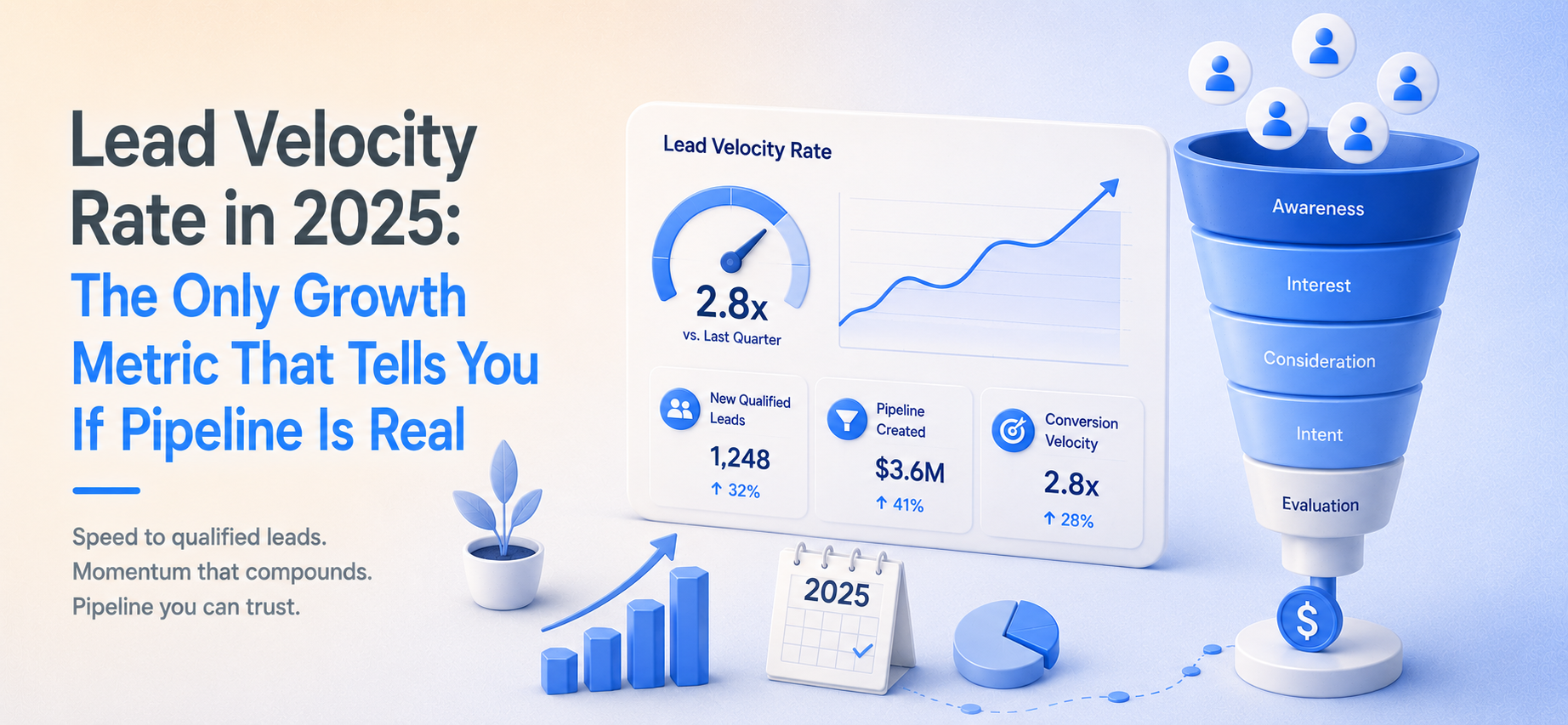
Lead Velocity Rate measures the month-over-month growth in qualified lead volume. Simple formula, big implications:
LVR = (Qualified Leads This Month − Qualified Leads Last Month) ÷ Qualified Leads Last Month
The point isn’t just “more leads.” It’s acceleration.
If LVR is consistently positive, your funnel is growing in a way that should create more pipeline in the future. If LVR is flat or negative, your growth engine is slowing down—even if other metrics still look strong today.
For demand gen leaders, LVR matters because it answers three questions that traditional funnel metrics don’t:
And for tech companies selling into director-level and above buyers, that last point is everything. If your LVR is driven by the wrong personas or the wrong accounts, it’s a vanity rocket: fast lift-off, no orbit.
The teams that win with LVR in 2025 treat it less like a scorecard and more like a steering wheel.
Common Challenges Marketers Face
Even teams that track LVR often get blindsided by what it doesn’t guarantee.
LVR can rise while pipeline stalls
This is the most common failure mode. Leads grow. LVR looks great. But the leads aren’t converting into meetings or opportunities.
Why? Because velocity at the top of the funnel means nothing if there’s friction right after the click.
Lead growth is disconnected from sales-ready conversations
A lead can be “qualified” by scoring rules and still be unready for a sales conversation. Especially in tech, where buyers self-educate quietly and avoid vendor engagement until late.
When LVR rises but SALs don’t, it usually signals a missing engagement layer between intent and outreach.
Director-level buyers are harder to convert with automation alone
Your LVR might be fueled by mid-level inflow, while the people who actually sign contracts stay unreachable. That’s how you end up with volume and no movement.
The truth is: director+ buyers don’t behave like software trial users. They respond to relevance, timing, and real human interaction—not a sixth nurture email.
Marketing ops becomes a bottleneck
A faster funnel creates pressure downstream: routing, enrichment, scoring adjustments, handoff playbooks. If your systems can’t keep up, your LVR becomes a load problem instead of a growth signal.



.png)

%201.png)


.png)


Solutions That Work
To make LVR meaningful, you don’t just need more leads. You need faster conversion from lead to conversation in the right accounts.
That’s where a human engagement layer changes the game.
Convert velocity into director-level meetings faster
If your qualified leads are accelerating, your ability to act on them quickly has to accelerate too. When follow-up lags, intent cools. When intent cools, pipeline flatlines.
Site Ascend is built for that exact moment—turning lead spikes into real conversations by reaching the right buyer while they’re still warm. Instead of waiting for SDR bandwidth to appear, teams can push qualified opt-ins or target-account surges straight into meeting-setting workflows.
Protect sales from “velocity noise”
High LVR can drown sales if qualification doesn’t get stricter as volume rises.
The best demand gen teams use a two-step filter:
That’s the sweet spot for outbound qualification: validating interest live, not guessing it from a score.
Use LVR to prioritize channel motion
If you sell through partners or run co-marketing plays, LVR becomes a shared growth signal: “Are we expanding demand together, or are we just generating activity?”
Channel programs succeed when velocity extends into partner-sourced meetings, not just partner-attributed leads. Site Ascend supports this with white-labeled outreach execution behind your partners, funded through MDF and aligned to your velocity goals.
Ensure event leads don’t decay
Events still drive LVR in tech—but only if lead engagement continues after registration.
Site Ascend’s outbound-first attendee procurement plus SMS support keeps registrants on track and sets up faster post-event conversion into meetings. The goal isn’t turnout. It’s pipeline acceleration.
Actionable Steps for Marketers
Here’s a practical LVR playbook you can run this quarter:
1. Track LVR by target-account lead growth, not just total leads.
If your LVR isn’t rising inside your ICP accounts, it’s not real growth.
2. Set a “speed-to-human” SLA.
Define how quickly a qualified lead gets a live touch (call/SMS/meeting ask). Aim for hours, not days.
3. Tighten qualification as LVR rises.
Higher velocity should increase selectivity, not lower it. Your scoring system needs a “quality throttle.”
4. Route hot leads straight into meeting workflows.
Don’t rely on nurture to do sales’ job. When intent spikes, move to conversation.
5. Use LVR drops as an early warning system.
When LVR slows, don’t just increase spend. Investigate:
Comparison of Market Solutions
When funnels break at higher velocity, teams usually reach for one of three approaches:
In-house SDR/BDR expansion
Upside: total control, tight brand alignment.
Tradeoff: slow to scale, expensive, and vulnerable to turnover. If LVR spikes unexpectedly, internal teams often can’t absorb the volume fast enough to preserve intent.
Automation-heavy nurture and scoring
Upside: efficient, low marginal cost.
Tradeoff: great at capturing interest, weak at converting it into real conversations—especially with senior buyers. Automation can signal who is interested, but not why, how much, or whether they’ll meet.
Outsourced human engagement (performance-based)
Upside: scales with your LVR, protects speed-to-lead, and adds a live qualification layer before sales.
Tradeoff: only works if the partner is aligned to meeting outcomes, not activity volume.
This is where Site Ascend stands apart: the model is built around meetings that actually occur, not dials, not leads, not booked slots that no-show later. With U.S.-based teams focused on director+ buyers and real-time reporting, velocity turns into pipeline without turning into noise.
Conclusion
In 2025, Lead Velocity Rate is still the most honest growth metric demand gen teams have—but only if you respect what it’s trying to tell you.
LVR doesn’t just measure lead growth. It exposes whether your engine is building real pipeline momentum or inflating a funnel that can’t convert.
If your LVR is rising and pipeline isn’t, the fix isn’t more content or more spend. It’s faster action, tighter qualification, and a human engagement layer that turns warm intent into director-level meetings before it cools.
What’s a “good” Lead Velocity Rate for B2B tech?

Can LVR rise even if deal velocity is slow?
How quickly should teams act on qualified leads to protect LVR?


Start your pilot campaign today and explore the full range of Site Ascend's demand generation capabilities. Experience firsthand how we can enhance your efficiency, streamline your processes, and drive growth.
RELATED