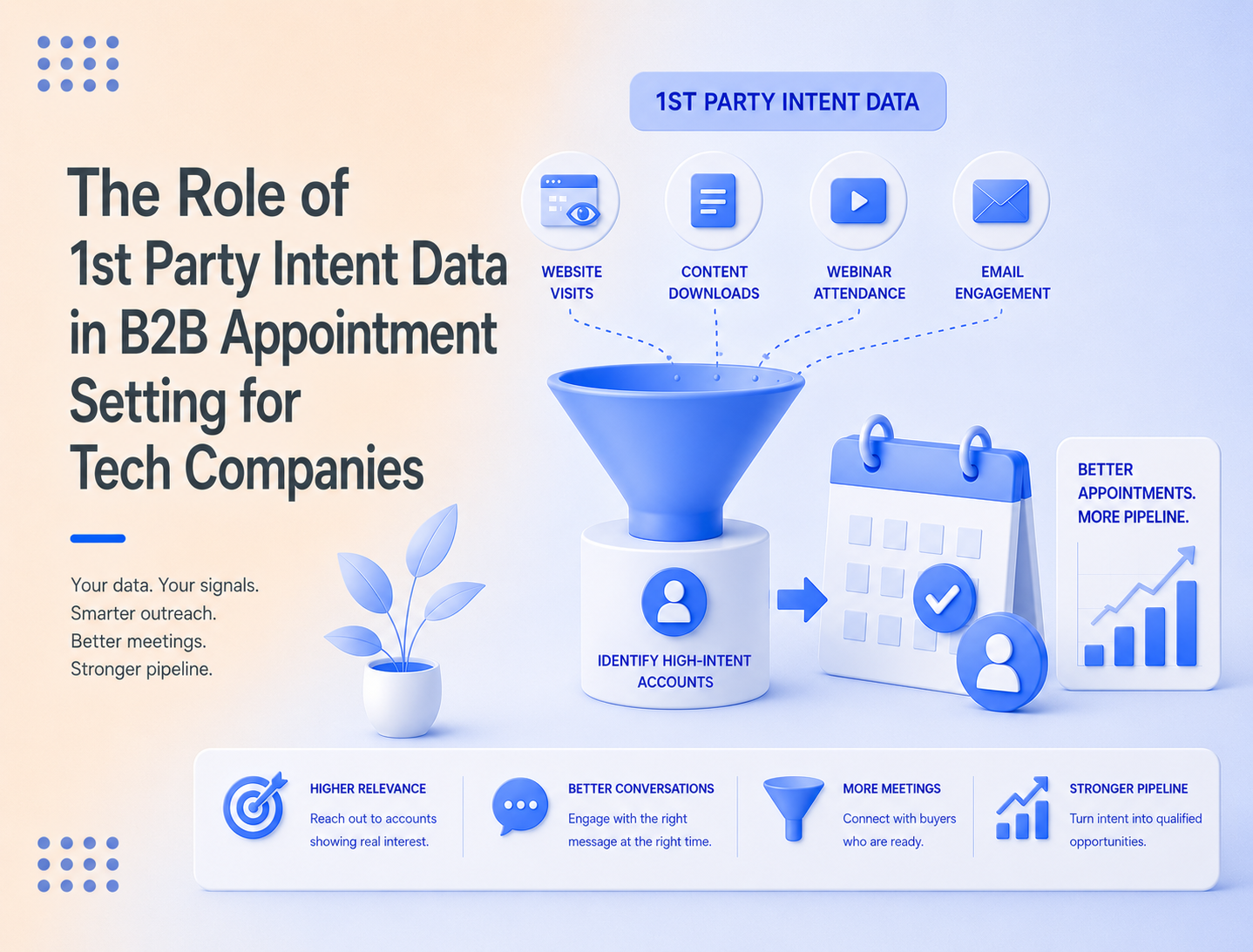
The Role of 1st Party Intent Data in B2B Appointment Setting for Tech Companies
B2B Appointment Setting


Stop reporting MDF ROI with “leads” that never convert. Use a meetings-first scorecard—accepted meetings, show rate, and conversion-to-pipeline—to prove partner spend is driving real revenue.
-
Channel Marketing
Introduction
If you manage channel or partner marketing, you already know the MDF problem: your dashboard fills up with activity, but your pipeline report stays stubbornly flat.
Leads delivered. Clicks captured. Webinar registrations. Badge scans. Form fills.
And then… nothing.
The issue usually isn’t effort—it’s measurement. MDF programs often get judged on volume metrics that look impressive but don’t predict pipeline. Meanwhile, Sales is evaluating a different reality: Did anything turn into real conversations with real decision-makers?
This post lays out a practical, meetings-first way to measure MDF ROI—so you can fund what converts, fix what doesn’t, and defend budget with confidence.
What “Measuring MDF ROI” Means for Demand Gen and Partner Marketers
Measuring MDF ROI isn’t just “spend vs. leads.” In a partner motion, ROI has to answer three questions:
If your MDF reporting can’t clearly connect spend → meetings → pipeline movement, it’s not ROI—it’s a recap.
A modern MDF ROI model is stage-based. You’re tracking outcomes through a funnel that both Marketing and Sales recognize:
That’s the difference between “We generated 800 leads” and “We created 22 director-level meetings, 18 occurred, and 6 became qualified opportunities.”
Common Challenges Marketers Face
1) MDF success gets defined by “leads,” not pipeline
Partners often report what’s easiest to produce quickly: lead counts. But leads are a noisy signal—especially for enterprise and complex B2B sales.
2) Sales doesn’t trust the output
If meetings aren’t truly aligned to ICP (account fit, persona fit, intent fit), Sales either rejects them—or accepts them and no-shows pile up.
3) Attribution becomes a political debate
Partner managers want credit. Demand gen wants clarity. Sales wants results. Without shared definitions and a shared scoreboard, MDF performance turns into opinions.
4) The “handoff gap” kills conversion
MDF programs frequently fail in the middle: interest is captured, but there’s no consistent process to convert it into scheduled, attended conversations with the right titles.



.png)

%201.png)


.png)


Solutions That Work
To measure MDF ROI in a way that predicts pipeline, you need two things:
Here’s what that looks like in practice.
Solution 1: Replace lead volume with a meetings-first scorecard
If MDF is meant to create pipeline, your core MDF metrics should behave like pipeline predictors—not vanity outputs.
A practical MDF ROI scorecard includes:
A) Quality of reach (are we in the right places?)
B) Conversion to real conversations (is Sales actually getting meetings?)
C) Pipeline movement (did it progress?)
The key is to track occurred meetings as the “bridge metric” between marketing activity and pipeline creation.
Solution 2: Standardize what counts as a “sales-ready” partner meeting
If your definition of success is fuzzy, your reporting will be fuzzy.
A sales-ready MDF meeting should meet a minimum standard across three dimensions:
When these are clearly defined upfront, you eliminate two common failure points:
Solution 3: Use a conversion layer that turns MDF interest into attended meetings
Most MDF programs lose value because they stop at interest capture.
A “conversion layer” is the operational step that takes MDF-engaged accounts and turns them into:
This is where Channel Marketing appointment setting becomes a direct lever on MDF ROI.
How Site Ascend fits here (only the relevant program):
Site Ascend’s Channel Marketing program is built specifically for MDF-funded, white-labeled appointment setting—so partner teams can convert funded programs into meetings with director+ decision-makers. The model is outcome-oriented and reporting-forward:
When MDF ROI is measured in meetings and pipeline, execution has to reliably produce meetings—not “leads delivered.”
Actionable Steps for Marketers
Here’s a simple checklist you can use to tighten MDF ROI reporting and improve pipeline outcomes immediately.
A meetings-first MDF ROI checklist
1) Define success in 3 layers
2) Lock meeting acceptance criteria with Sales
3) Report MDF performance as a funnel
Instead of one metric (“leads”), report:
4) Calculate two “truth metrics”
These cut through attribution noise and give leadership something comparable across programs.
5) Require show-rate visibility
If your reporting stops at “scheduled,” you’re missing the most important predictor of ROI: attendance.
6) Review MDF programs like a portfolio
Fund what produces occurred meetings and pipeline. Rework or cut what doesn’t—even if it generates “a lot of leads.”
Comparison of Market Solutions
There are a few common approaches to MDF execution and measurement—and they each come with tradeoffs.
Option 1: Partner reports + lead volume
What it looks like: Partners deliver lead lists, activity recaps, and basic engagement metrics.
Where it works: Low-consideration offers, simple sales motions.
Where it breaks: Complex B2B, enterprise, director+ personas. Lead volume doesn’t predict pipeline.
Option 2: In-house channel team runs everything
What it looks like: Your team manages targeting, outreach, scheduling, and reporting.
Where it works: When you have enough headcount and process maturity.
Where it breaks: Scale and consistency. Partner programs multiply fast, and meeting quality becomes uneven.
Option 3: Outsourced “leads delivered” programs
What it looks like: You pay for lead lists, contacts, or “appointments” that aren’t truly verified.
Where it works: When you only need top-of-funnel activity.
Where it breaks: Sales trust. You may hit lead goals and still lose pipeline outcomes.
Option 4: Meetings-first channel execution (Site Ascend’s model)
What it looks like: MDF is measured and managed around director-level meetings that occur, with visibility into acceptance and show rates.
Why it tends to win for MDF ROI: It aligns cost to outcomes, keeps partner programs white-labeled, and makes reporting defensible because it’s built around real conversations—not lead volume.
Conclusion
MDF ROI becomes simple when you measure what actually predicts pipeline:
If your MDF reporting still centers on “leads delivered,” you’ll keep fighting the same battle every quarter: lots of activity, unclear impact, and budget pressure.
If you want a cleaner model, start with a meetings-first scorecard—and a channel execution layer that can reliably convert MDF into sales-ready conversations.
If you’re ready to test a meetings-first MDF approach, Site Ascend can help you pilot a white-labeled channel marketing program focused on director+ meetings that occur—with real-time reporting and outcome-based accountability. Contact Site Ascend.
What’s the best single metric for MDF ROI?

What’s a good MDF meeting show rate?
How do I prove MDF is influencing pipeline if attribution is messy?


Start your pilot campaign today and explore the full range of Site Ascend's demand generation capabilities. Experience firsthand how we can enhance your efficiency, streamline your processes, and drive growth.
RELATED