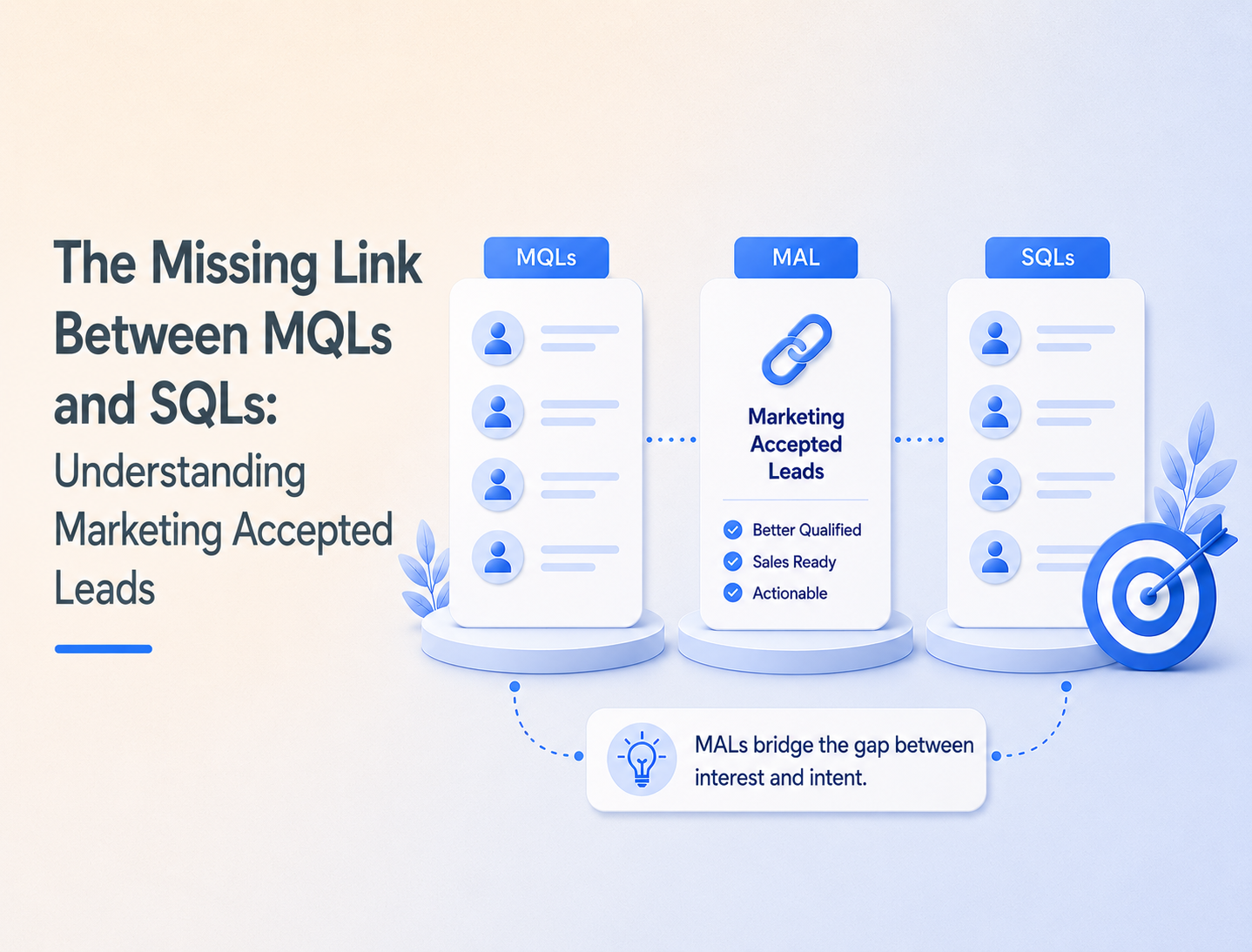
The Missing Link Between MQLs and SQLs: Understanding Marketing Accepted Leads
Demand Generation


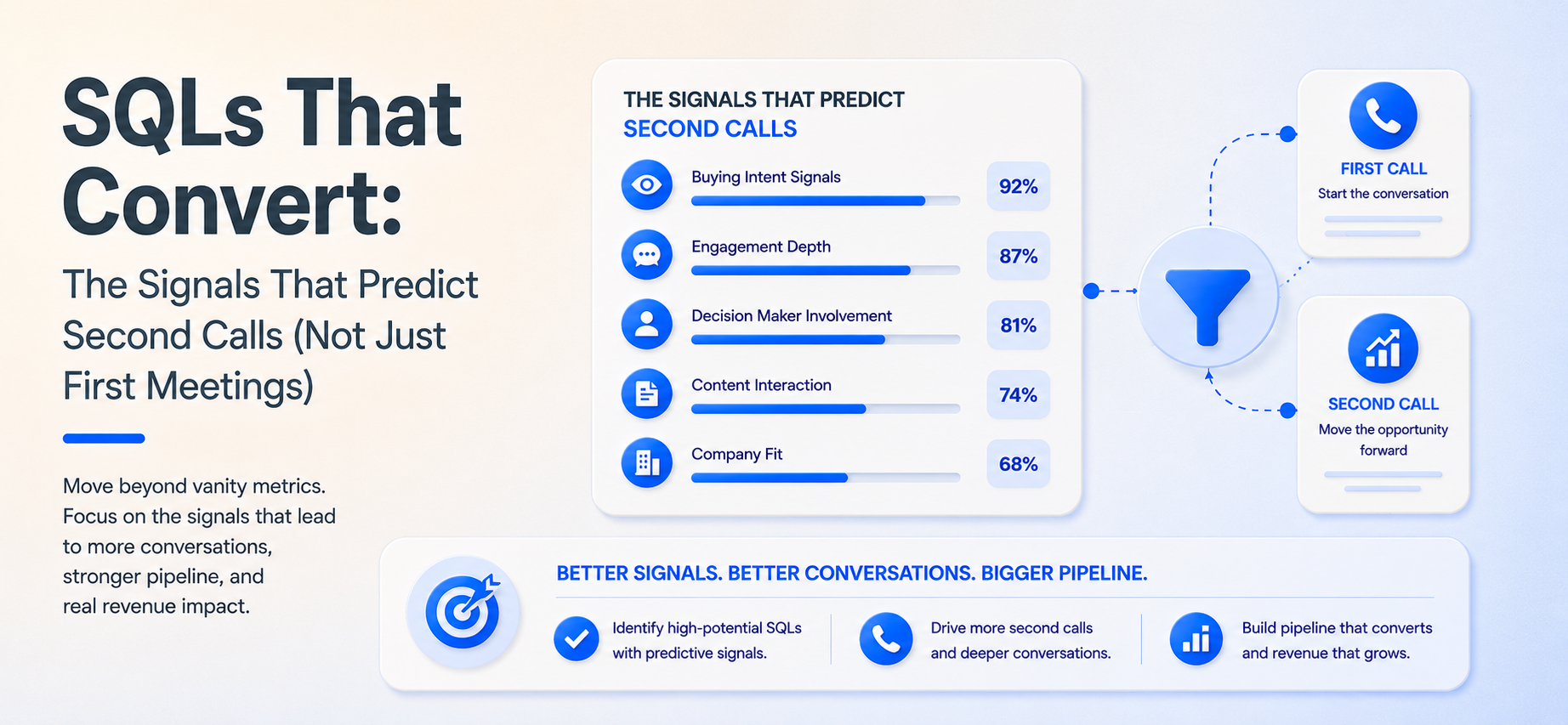
SQLs aren’t a label—they’re a conversion standard. This blog breaks down the signals that predict second calls (Director+ relevance, problem clarity, urgency, internal motion, and next-step design) and shows how Site Ascend helps teams turn SQLs into meetings that occur and progress.
-
Sales Alignment
Introduction
Enterprise demand gen has a scoreboard problem.
Most teams measure what’s easiest to count:
But revenue doesn’t care about what got tagged or what got scheduled.
Revenue cares about what progressed.
If your SQLs aren’t consistently turning into second calls, it’s not because your team can’t generate interest. It’s because your SQL definition is missing the signals that predict follow-through: decision relevance, urgency, and an executable next step.
This blog breaks down the SQL signals that correlate with second-call conversion—and how Site Ascend supports those signals through Lead Qualification and Executive Meetings built to produce Director+ meetings that occur and advance.
What SQL means for demand generation marketers (and why “SQL” often fails)
A Sales Qualified Lead should mean:
Sales has enough confidence to invest time because there’s a credible path forward.
In practice, SQL often becomes a status marker:
Those can be useful triggers, but they don’t guarantee progress.
In enterprise buying, the first meeting is rarely the win. It’s the audition. The real question is:
What makes sales believe a second meeting is worth scheduling?
That answer lives in signals—not in labels.
Common challenges marketers face
Meetings happen, but momentum doesn’t
You get the call. Everyone is polite. The prospect says they’ll “take a look.”
Then the deal disappears into follow-up purgatory.
The stakeholder is engaged but not empowered
A motivated evaluator can’t always create action. Without Director+ sponsorship (or a clear path to it), the second call becomes unlikely.
“Interest” gets mistaken for “Need”
Prospects often explore vendors before a project is real. If the problem isn’t explicit, sales has nothing to anchor next steps to.
Urgency isn’t identified
Without a trigger (renewal, mandate, audit, migration, deadline, planning window), there’s no reason to prioritize a second conversation.
Next steps are not designed
A surprising amount of first meetings end without a concrete follow-up motion. No agenda, no stakeholders identified, no shared outcome.
Second calls don’t “happen.” They’re engineered.



.png)

%201.png)


.png)


Solutions That Work
To improve second-call conversion, define SQL around conversion signals, then operationalize them consistently.
The signals that predict second calls
These are the “non-negotiables” that make a second meeting worth scheduling.
Decision relevance
Problem clarity (in the prospect’s words)
Timing trigger (“why now”)
Evidence of internal motion
Next-step design
How Site Ascend operationalizes these signals
Site Ascend supports SQL conversion primarily through Lead Qualification and Executive Meetings—because both are built around turning engagement into accountable conversations, not just activity.
Lead Qualification (for engaged opt-ins that need clarity)
This helps ensure the first sales call isn’t forced to do all the heavy lifting. The qualification motion is designed to confirm:
Executive Meetings (for Director+ engagement that holds)
If decision relevance is the strongest predictor, enforce it structurally. Executive Meetings focus on:
When the right stakeholder shows up and the meeting holds, second calls stop being wishful thinking and start becoming a measurable output.
Actionable Steps for Marketers
Use this as a lightweight internal standard for “SQL that converts.”
The Second-Call SQL checklist
Decision relevance
Problem
Trigger
Internal motion
Next step
The weekly metrics that expose real SQL quality
Instead of celebrating SQL volume, track conversion health:
If these rise together, SQL is functioning as a standard—not a label.
Comparison of Market Solutions
Example 1: The Procurement View
When procurement (or finance) evaluates “pipeline support” vendors, they’re usually not debating tactics. They’re choosing which outcome they want to buy—and which tradeoffs they’re willing to live with.
Here are the three most common buying outcomes, and how they tend to show up once the program is live.
Procurement outcome: Cleaner qualification standards
This is the “tighten the definition” purchase. The goal is to reduce noise by making everyone agree on what “qualified” means—better scoring logic, stricter routing, clearer SLAs, cleaner handoffs. It can absolutely improve alignment and remove obvious junk.
The catch is that standards don’t create conversations. If your core issue is that the right stakeholders aren’t engaging—or that urgency never gets surfaced—then you’ll still see SQLs stall after the first meeting, just with nicer labels.
Procurement outcome: Faster time-to-meeting
This is the “speed wins” purchase. The organization wants leads worked immediately, meetings scheduled quickly, and calendars filled while intent is fresh. It’s attractive because it’s measurable and it feels like momentum.
The tradeoff shows up in second-call conversion. Speed can book meetings before Authority, Need, and Urgency are actually confirmed. You get more first calls, but fewer that justify a real next step—so the pipeline impact stays inconsistent.
Procurement outcome: Higher probability of progression
This is the outcome enterprises ultimately defend in QBRs: meetings that occur, with decision-relevant stakeholders, that produce a next step. Instead of optimizing for activity or speed, the program optimizes for conversion signals—Director+ involvement, a clear problem, a timing trigger, and a designed follow-up motion.
This is where Site Ascend fits best. The model is built around verifying qualification early and delivering Director+ meetings that occur—so sales effort goes into conversations with a realistic path to a second call, not just a full calendar.
Conclusion
SQLs don’t convert because they’re marked “qualified.” They convert because the signals are present:
If your team wants to pilot a motion that improves second-call conversion by standardizing these signals—and delivering Director+ meetings that occur—contact Site Ascend to discuss a pilot using Lead Qualification and Executive Meetings.
Is a booked meeting the same as an SQL?

What’s the biggest predictor of second-call conversion?
How do we raise SQL quality without killing volume?


Start your pilot campaign today and explore the full range of Site Ascend's demand generation capabilities. Experience firsthand how we can enhance your efficiency, streamline your processes, and drive growth.
RELATED
.png)