Optimizing Lead Routing to Improve Conversion Rates in Enterprise Marketing
Enterprise Marketing


ANUM (Authority, Need, Urgency, Money) often beats BANT for modern buying committees by prioritizing senior stakeholders, real problems, and timing triggers before budget certainty. Learn how Site Ascend applies ANUM to improve Director+ meeting quality and increase next-step conversion.
-
Demand Generation
Introduction
BANT still shows up in board decks, CRM fields, and lead routing rules. But in enterprise B2B tech, it often fails for one simple reason:
Buying decisions rarely move in a straight line—especially not at the start.
Demand gen is expected to create pipeline momentum before budget is finalized, before every stakeholder is present, and before procurement timelines are locked. When you force early conversations through a BANT lens, you end up disqualifying accounts that are actually winnable—or worse, passing “qualified” meetings that stall immediately after the call.
That’s why many high-performing teams shift to ANUM:
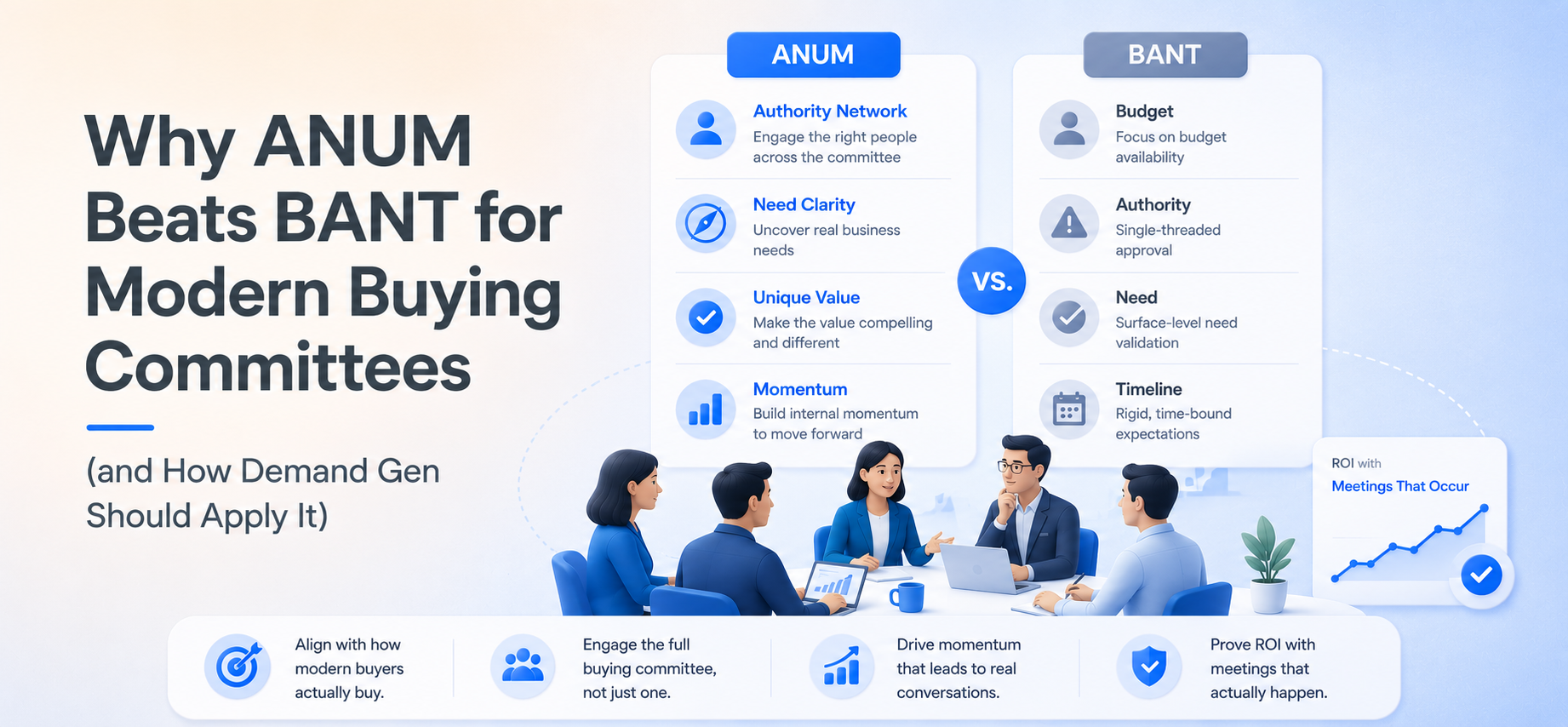
ANUM = Authority, Need, Urgency, Money
ANUM doesn’t ignore budget. It just puts Authority and Need first, which better matches how modern buying committees form and how deals actually progress.
What ANUM Qualification means for demand generation marketers
ANUM is a meeting-quality standard. It answers the question demand gen leaders get judged on:
“Will sales take this meeting seriously—and will it convert to a next step?”
Here’s the practical definition of each element:
Authority
Not “are they the signer,” but:
For enterprise motions, Director-level and above is often the cleanest proxy for this.
Need
A real business problem—not curiosity.
Urgency
A time trigger that creates follow-through.
Money
Not “do you have budget approved,” but:
ANUM beats BANT because it prioritizes what creates motion early: the right stakeholder, a real problem, and a reason to act—then validates money as the deal takes shape.
Common challenges marketers face
1) BANT blocks deals that aren’t “budget-ready” yet
In enterprise buying, budget clarity often arrives after:
If your qualification requires firm budget too early, you’ll disqualify accounts that are mid-formation, not “unqualified.”
2) Authority drift creates meetings that don’t progress
Volume-based meeting motions tend to slide toward easier accepts:
These meetings happen, but stall—because no one can commit to next steps.
3) Need is assumed from engagement signals
Downloads, registrations, and partner co-marketing often create “interest,” not need. Without a clear problem statement, sales can’t anchor a second call.
4) Urgency is missing, so follow-up becomes optional
Even with the right account and a compelling topic, a meeting without urgency is easy to deprioritize.
5) Sales and marketing define “qualified” differently
Marketing counts meetings. Sales counts progress. ANUM is the bridge—because it defines “qualified” as decision-ready instead of activity-ready.



.png)

%201.png)


.png)


Solutions that work
ANUM becomes useful when it’s operationalized inside the motions you already run—not treated as a slide or an SDR script. Here’s how Site Ascend applies it where demand gen teams feel the most pain: Executive Meetings and Lead Qualification (and, when relevant, channel and event programs).
Executive Meetings: start with Authority to protect meeting quality
Site Ascend’s Executive Meetings are designed around 30-minute virtual meetings with Director-level and above stakeholders.
How that maps to ANUM:
Two differentiators make this practical, not theoretical:
Lead Qualification: turn opt-ins into sales-ready meetings without creating “MQL fights”
ANUM shines with opt-in follow-up because opt-ins often have Need signals but unclear Authority and Urgency.
Site Ascend’s Lead Qualification motion focuses on converting opt-ins into meetings when ANUM fundamentals are present:
Outcome: fewer “handed-off leads,” more meetings that sales will actually advance.
Channel Marketing and Event Marketing: use ANUM when those motions are expected to produce pipeline
If your partner or event motions are measured on pipeline contribution, ANUM provides guardrails:
Actionable steps for marketers
Here’s a practical way to apply ANUM this month—without changing your entire funnel.
The ANUM Meeting Readiness Checklist
1) Authority (required)
2) Need (required)
Capture one sentence:
3) Urgency (required)
Require one timing trigger:
4) Money (plausibility, not proof)
Confirm at least one:
Weekly program health metrics
If you can measure those three, you can operationalize ANUM—and optimize it quickly.
Comparison of market solutions
Here’s the market through a procurement lens—how buyers typically evaluate meeting and qualification solutions.
1) Lowest cost per activity
What you’re buying: attempts (dials, contacts, hours) or raw volume.
Why teams choose it: it’s easy to justify unit cost.
Where it breaks: incentives push quantity, and Authority/Urgency degrade—so ANUM fails and meetings stall.
2) Predictable volume
What you’re buying: booked meetings, registrations, or lead counts.
Why teams choose it: forecasting feels easier.
Where it breaks: “booked” ≠ “held,” and volume doesn’t guarantee Director+ or next steps—so sales trust erodes.
3) Defensible pipeline impact
What you’re buying: outcomes you can defend—meetings that occur, seniority standards, and clear next-step conversion.
Why teams choose it: it aligns with revenue metrics, not vanity metrics.
Why Site Ascend fits here: outcome-aligned payment (meetings that occur), Director+ targeting, U.S.-based contact center, and real-time reporting to manage quality in-flight.
Conclusion
BANT isn’t wrong—it’s just often out of order for how modern buying committees behave.
ANUM wins early because it prioritizes:
If your demand gen programs create meetings that stall after the first call, an ANUM-based pilot can tighten seniority, reduce “nice-to-have” conversations, and improve next-step conversion.
Contact Site Ascend to start a pilot focused on Director+ meetings that occur and advance—using ANUM as the standard for meeting readiness.
Is ANUM “better” than BANT in every scenario?

How do we avoid making ANUM feel like an interrogation?
What’s the fastest way to improve next-step conversion using ANUM?


Start your pilot campaign today and explore the full range of Site Ascend's demand generation capabilities. Experience firsthand how we can enhance your efficiency, streamline your processes, and drive growth.
RELATED