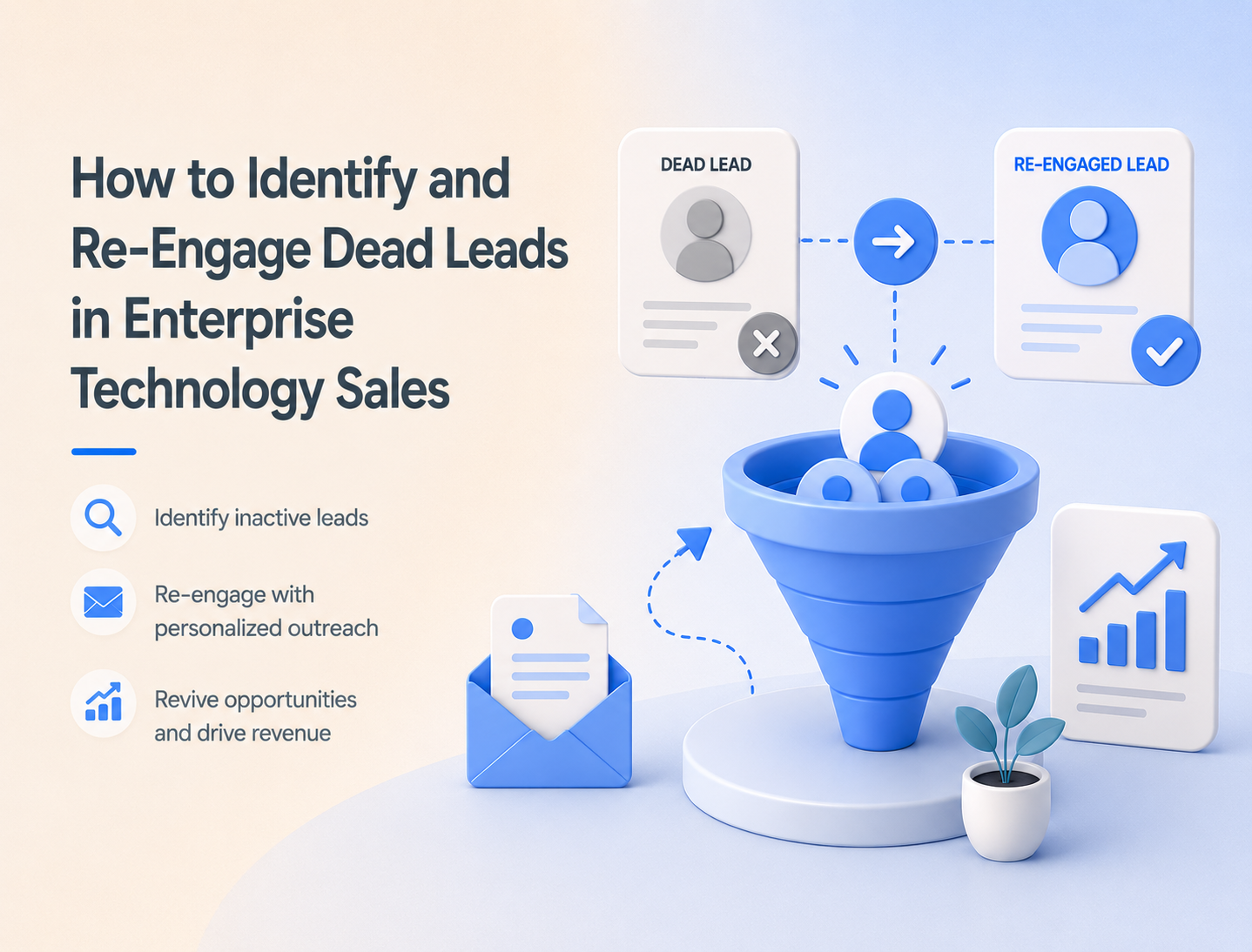
How to Identify and Re-Engage Dead Leads in Enterprise Technology Sales
Lead Management Strategies


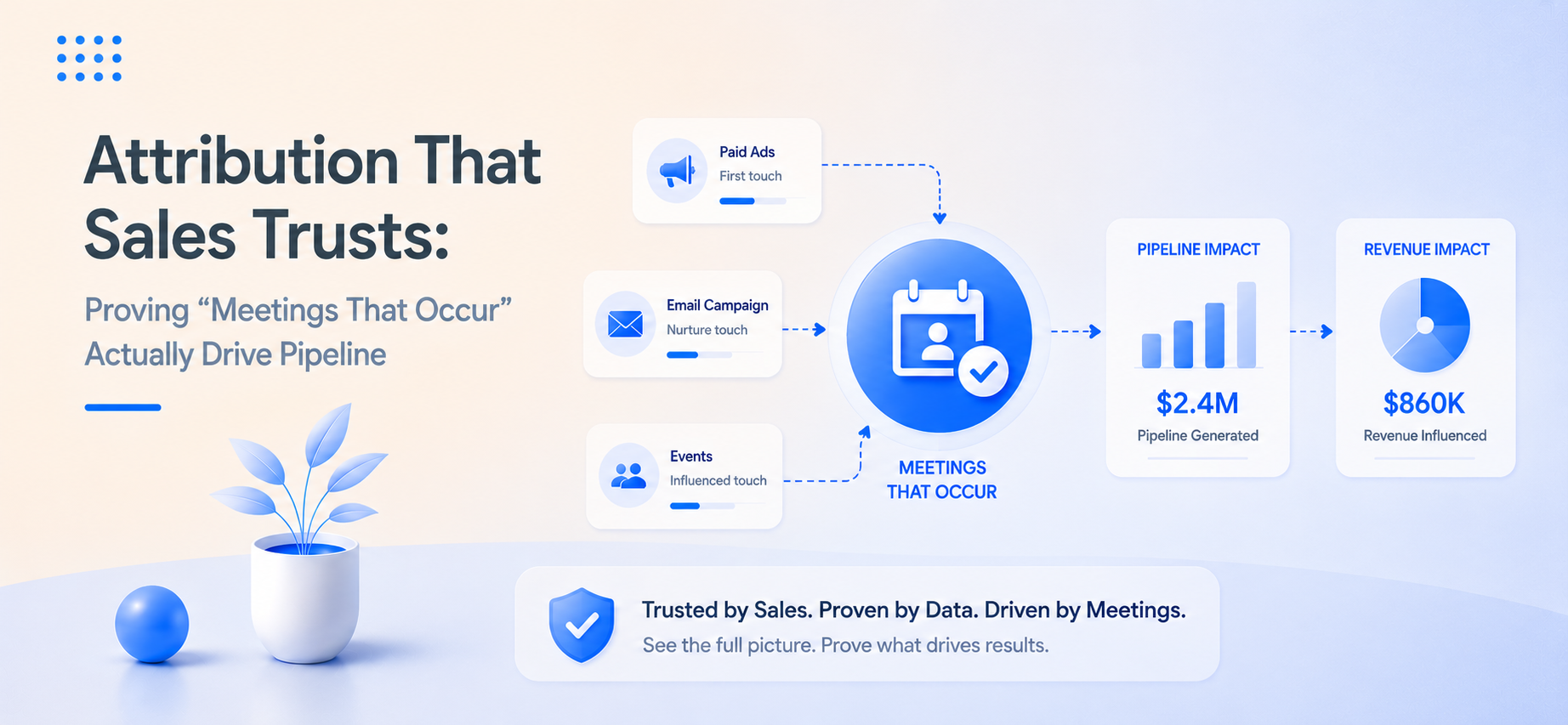
Attribution breaks down when marketing optimizes for signals—and sales is measured on outcomes. This post outlines a meeting-first attribution model that ties outreach and qualification to the metric that matters: director-level conversations that actually occur and move opportunities forward.
-
Revenue Operations & Pipeline Performance
Introduction
Most attribution debates aren’t really about data—they’re about trust.
Marketing wants credit for influence. Sales wants proof that pipeline is real. RevOps wants consistency. And when those three don’t align, attribution becomes a political exercise: screenshots of dashboards, arguments over “influenced” fields, and quarterly post-mortems where nobody feels like they won.
If you’re running demand gen in an enterprise environment, you already know the uncomfortable truth: plenty of “attributed” leads never become conversations. Plenty of “influenced” opportunities were going to happen anyway. And plenty of activity-heavy programs look great in reports while sales quietly ignores the output.
That’s why Site Ascend anchors performance around a simple standard: meetings that occur—with director-level and above stakeholders in target accounts. Not meetings “set.” Not meetings “accepted.” Meetings that actually happen.
This blog breaks down how to build an attribution model sales will trust—by starting with the only outcome that matters in enterprise demand gen: real conversations that advance deals.
What Attribution Models Mean for Demand Generation Marketers (and Teams That Own Pipeline)
An attribution model is simply a rule-set that answers:
“What should get credit when pipeline is created?”
In practice, most models try to connect marketing activity to revenue by assigning weighted credit across touchpoints (first-touch, last-touch, multi-touch, W-shaped, etc.). That works reasonably well in high-velocity funnels. It breaks down quickly in enterprise for a few reasons:
So the practical question becomes:
What do sales leaders actually trust as a signal that marketing is producing something usable?
For enterprise teams, the cleanest, lowest-debate answer is:
a qualified meeting that occurred—with the right level of stakeholder, in the right account, with the right context.
That’s exactly where Site Ascend fits: we help demand gen teams turn marketing signals into director+ meetings that happen, through:
The goal isn’t to “prove marketing did something.” The goal is to prove marketing created a conversation sales would choose to have again.
Common Challenges Marketers Face
1) Attribution credits the wrong thing (activity instead of outcomes)
If your model rewards MQL volume, clicks, or form fills, you’ll get more of those—regardless of whether sales sees pipeline.
The result: dashboards look strong while the meeting calendar stays light.
2) “Accepted” is not the same as “worked”
Many orgs treat SAL or “accepted” as a finish line. It isn’t. Sales can accept a lead to clear a queue and still never contact it meaningfully.
The result: marketing claims success; sales claims the leads weren’t real.
3) Enterprise meetings fail for operational reasons—not intent
In enterprise, meetings don’t fall apart because the buyer isn’t interested. They fall apart because:
The result: a program can look effective in reporting but create no lasting pipeline movement.
4) Channel and event programs produce “shared” leads that nobody owns
Partner-sourced leads, event registrants, and MDF campaigns frequently stall due to fuzzy ownership.
The result: attribution becomes a spreadsheet debate after the quarter ends.



.png)

%201.png)


.png)


Solutions That Work
If you want attribution sales will trust, you need a meeting-first operating system that turns signals into confirmed conversations—and then ties those conversations back to the programs that created them.
Here’s what that looks like in practice.
1) Anchor attribution to the “meeting that occurred” event
Attribution becomes dramatically simpler when your primary unit of value is not an MQL, not an SAL, not a click—but a completed meeting.
That’s why Site Ascend’s core model is pay-for-performance: you only pay for meetings that occur.
This changes the incentive structure immediately:
Meeting that occurred becomes your shared language across marketing, sales, and RevOps.
2) Treat qualification as part of attribution—not a separate problem
Most attribution models assume “lead quality” is handled somewhere else. In reality, that’s where the entire system breaks.
Site Ascend’s Lead Qualification program turns opt-in signals (downloads, webinars, inbound forms) into sales-ready conversations by doing the work most funnels avoid:
That means your attribution model can attribute value to a real conversion milestone, not a speculative one.
3) Use outbound dialing to convert weak signals into strong outcomes
For enterprise, “digital intent” often creates a large pool of ambiguous interest. Outbound dialing does two critical things:
That’s why Site Ascend relies on outbound dialing (not outsourced, not offshore) to convert signals into meetings—and uses SMS workflows to support event attendance and reduce no-shows.
When the meeting is the outcome, dialing becomes a core part of your attribution system because it turns attribution from “influence” into “conversion.”
4) Make partner and event programs attributable by enforcing a uniform meeting standard
Partner marketing and event marketing fail attribution because the “lead” definition changes every time. One partner sends a list. Another sends registrants. Another claims influence.
Instead, use one standard across every source:
Did the program create a director+ meeting that occurred?
Site Ascend’s Channel Marketing and Event Marketing programs are designed to make this possible by applying consistent:
Actionable Steps for Marketers
If you want a practical attribution model that sales will buy into, implement this meeting-first checklist.
The Meeting-First Attribution Checklist
1) Define the conversion event you will attribute to
2) Standardize what “qualified” means (in operational terms)
3) Measure show rate as a first-class KPI
4) Track lead-to-meeting velocity
5) Build reporting around outcomes, not channel narratives
6) Reduce lead risk with pay-for-performance execution
If you want this checklist operationalized across inbound leads, partner programs, and event outreach, Site Ascend is built specifically to run that motion.
Comparison of Market Solutions
Example 1: The Procurement View
If you’re evaluating ways to produce attributable pipeline, most options fall into three buckets—each with different procurement outcomes.
Outcome 1: “We want predictable cost, even if outcomes vary.” (In-house / SDR-led)
What it looks like: internal SDRs run outreach and follow-up; marketing reports on activity metrics and assisted pipeline.
Where it breaks: SDR time is expensive, turnover is high, and meeting quality is inconsistent—especially for director-level stakeholders.
Outcome 2: “We want coverage quickly, but we need accountability.” (Traditional outsourced lead gen)
What it looks like: outsourcing promises more meetings and more leads, often priced by activity or minimum commitments.
Where it breaks: misaligned incentives—providers can get paid for meetings set, regardless of whether they occur, or for lead volume that sales ignores.
Outcome 3: “We want to reduce risk and pay for outcomes.” (Pay-for-performance meetings)
What it looks like: you pay for meetings that happen with the right stakeholders, with clear targeting and transparent reporting.
Why it holds up: attribution becomes cleaner because the model is tied to a shared, verifiable conversion event—a meeting that occurred.
This is the lane Site Ascend operates in—combining director+ targeting, U.S.-based outreach, white-labeled execution, and real-time reporting with a pay-for-performance model designed to reduce lead risk.
Conclusion
Attribution that sales trusts isn’t a dashboard tweak. It’s an operating decision: stop treating activity as value and start treating meetings that occur as the primary conversion standard.
When your programs are measured by completed conversations—and supported by consistent qualification, confirmation, and reporting—you reduce lead risk, improve sales acceptance, and make pipeline attribution far less subjective.
If you want to shift your attribution model toward outcomes and prove that “meetings that occur” drive real pipeline, Site Ascend can help you pilot a meeting-first program across executive meetings, lead qualification, channel marketing, or event marketing. When you’re ready, we can help you book more director-level conversations—without adding SDR headcount.
Which attribution model works best for enterprise demand gen?

Why doesn’t “influenced pipeline” settle attribution debates?
How do you prove a meeting is actually valuable (not just booked)?


Start your pilot campaign today and explore the full range of Site Ascend's demand generation capabilities. Experience firsthand how we can enhance your efficiency, streamline your processes, and drive growth.
RELATED