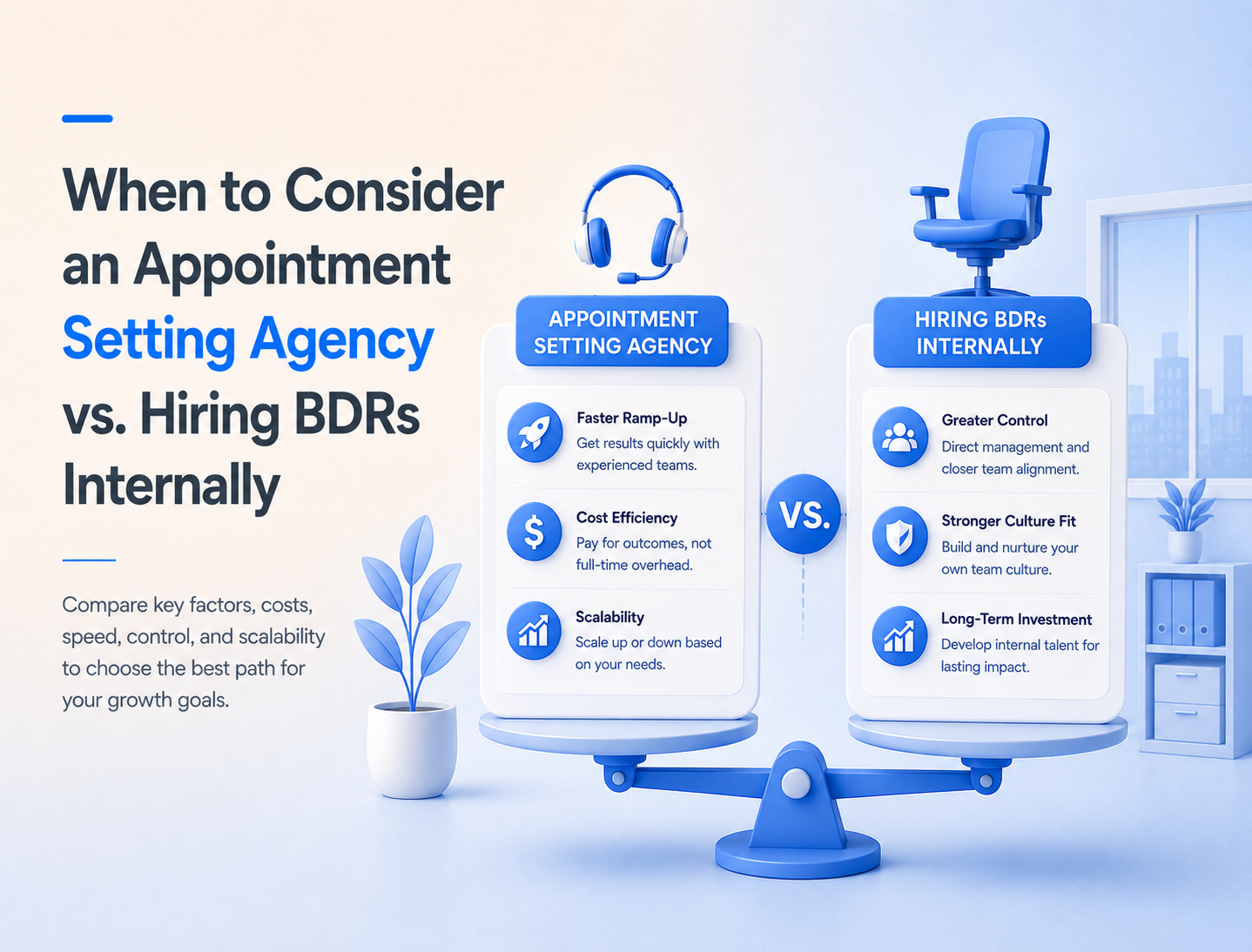
When to Consider an Appointment Setting Agency vs. Hiring BDRs Internally
B2B Appointment Setting


Channel incentives only work when they’re designed to pay for real progress—not partner activity. This guide shows how enterprise demand gen teams structure outcome-based incentives, prevent channel conflict, and turn MDF-style programs into director+ meetings that actually happen.
-
Channel Marketing
Introduction
Channel incentives are supposed to be the easy button.
Fund a campaign. Give partners a reason to care. Watch deal registrations roll in.
But in enterprise demand gen, incentives often create something else: activity that looks like momentum—without the director-level conversations needed to move real opportunities forward.
You see it in the metrics:
The problem isn’t that incentives don’t work. It’s that most incentive models reward the wrong unit of progress.
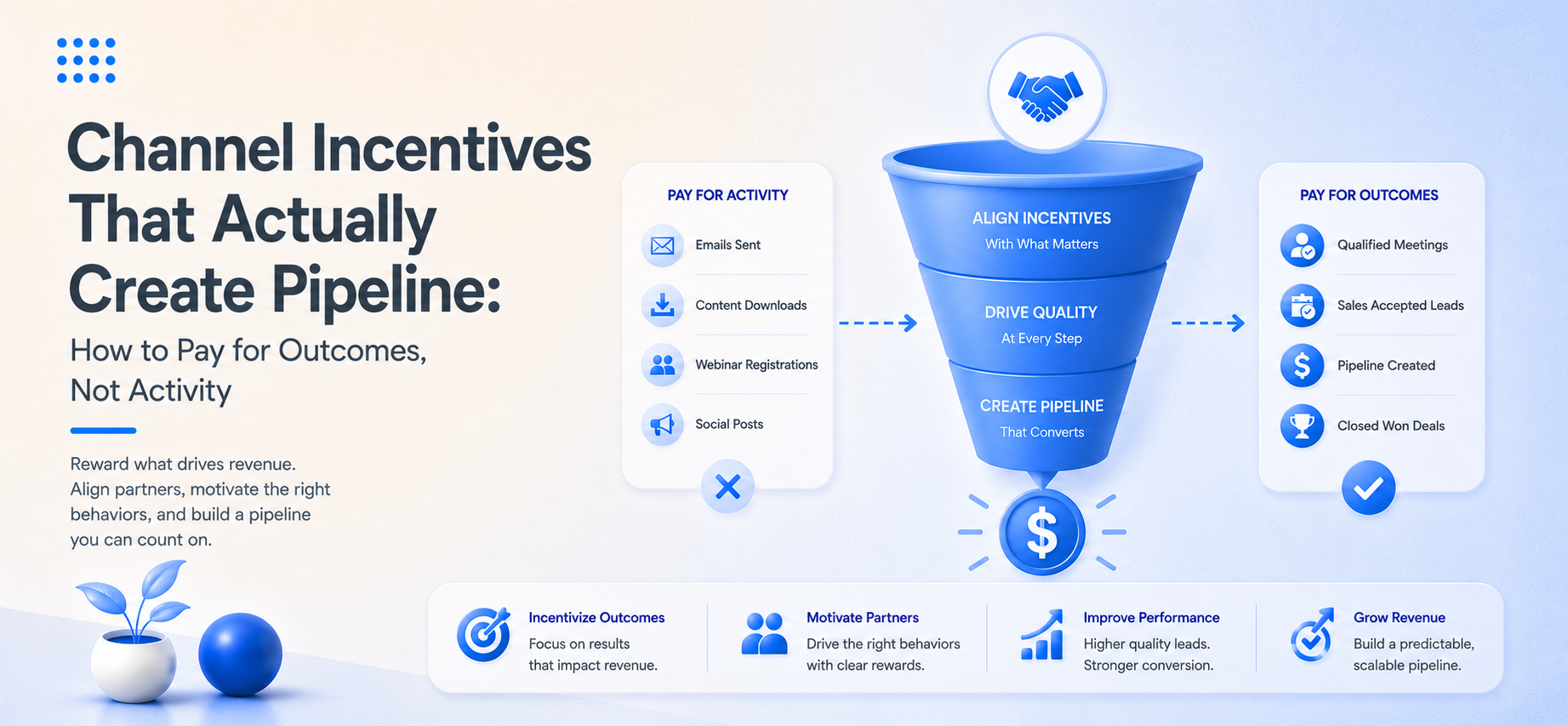
If your channel incentives pay for activity (attendance, registrations, clicks, “leads”), you’ll get activity. If they pay for outcomes (qualified director+ meetings that happen), you’ll get pipeline.
This post breaks down what “Channel Incentives” should mean for demand gen leaders, why most programs underperform, and how to operationalize an outcome-based model that partners will adopt—and sales will actually value.
What “Channel Incentives” Means for Demand Gen Leaders
In enterprise B2B, channel incentives are not just motivation. They’re a management system.
They set expectations for:
Done well, incentives align three groups that typically operate on different clocks:
Done poorly, incentives become a participation trophy—easy to launch, hard to defend in a QBR.
Here’s the shift that matters:
In enterprise channel marketing, incentives should fund “progress” — not “presence.”
Progress means the program reliably produces:
That’s the standard. Anything else is overhead.
Common Challenges Marketers Face
Channel incentives fail in predictable ways. The details vary by org, but the breakpoints usually show up in the same places.
Incentives reward the easiest thing to count
Registrations and lead volume are simple. They’re also noisy.
When you reward “volume,” you train partners to optimize for low-friction conversions—often outside your ICP, outside your buying committee, or too early to convert.
Partners can’t execute consistent follow-up
Even strong partners have competing priorities: multiple vendors, multiple offers, limited coverage.
If the incentive assumes the partner will do fast, consistent, high-quality follow-up… you’re betting your pipeline on someone else’s capacity planning.
Sales doesn’t trust the inputs
Sales teams aren’t allergic to partner leads—they’re allergic to uncertainty.
If the lead lacks context (role, need, urgency, buying process), the rep has to “rediscover” the deal. And if that happens repeatedly, sales learns to ignore the channel.
Director+ access breaks down at the moment it matters
Enterprise programs can generate interest at manager level—then stall because the economic buyer isn’t in the conversation.
If your incentives don’t explicitly drive director+ engagement, you’ll get stuck with “influencer activity” and limited conversion to next steps.
Attribution becomes an argument, not an insight
When outcomes don’t match the spend, everyone looks for a defensible story:
All of those can be true. None of them help you scale.
The fix is not another dashboard. It’s changing what the incentive funds and how execution is operationalized.



.png)

%201.png)


.png)


Solutions That Work
The simplest way to improve channel incentive ROI is to stop paying for participation and start paying for verified progress.
That’s where an outcome-based approach changes the economics and the internal conversation.
1) Treat “a meeting that occurs” as the base unit of value
If your channel incentive doesn’t produce a conversation, it didn’t produce pipeline.
Site Ascend is built around this idea: only pay for meetings that occur. That aligns incentives across marketing, partners, and sales because the spend is tied to something everyone agrees matters.
It also forces clarity upfront:
Outcome-based incentives don’t replace your strategy—they make it measurable.
2) White-label execution so partners can stay the hero
A lot of channel programs underperform because they create friction for the partner. The partner has to:
When outreach can be executed white-labeled, the partner keeps ownership of the relationship while the program gets consistent operational execution.
This matters because the best partner programs feel seamless to the market—one motion, one message, one clear next step.
3) Design for director+ from the start (not as a “next phase”)
Enterprise buying committees don’t “promote” a deal up the chain just because you ran a campaign.
If the incentive is meant to create pipeline, it has to drive engagement with director+ roles intentionally—through targeting, outreach, and qualification standards.
Site Ascend’s director+ focus is a structural advantage here. Instead of trying to climb the org chart after the fact, the program is designed to start at the level where next steps can actually be owned.
4) Use outbound as the engine when outcomes matter
Channel incentives often rely on passive response (partners emailing lists, posting offers, hoping buyers raise their hand).
That can work for awareness. It’s unreliable for pipeline—especially in enterprise.
Site Ascend’s outreach model uses outbound dialing to drive attendance or meetings, then supports with SMS workflows to reduce drop-off and improve show rates. The point isn’t the channel—it’s the outcome: a real conversation, with the right person, that actually happens.
5) Make reporting operational, not decorative
Most channel dashboards are built for post-mortems.
Outcome-based programs benefit from real-time reporting that’s actionable:
That’s the difference between “tracking” and “steering.”
Actionable Steps for Marketers
If you want channel incentives that create pipeline, use this checklist as a practical reset. It works whether you’re running MDF, co-op, SPIFFs, or partner-sourced motions.
A quick Channel Incentive “Outcome Audit”
Define the outcome first
Lock your guardrails
Build a clean handoff
Create a minimum viable incentive structure
Operationalize execution
If you want a fast litmus test: If a partner can “complete” your incentive without creating a real conversation, you’re paying for activity.
Comparison of Market Solutions
Most organizations land in one of three models when they try to turn channel incentives into pipeline. Each can work—but only one consistently scales without creating hidden costs.
Model A: In-house partner + SDR follow-up
This is the “we’ll do it ourselves” approach. It can be effective when you have:
The tradeoff is that in-house teams get pulled in multiple directions. Channel follow-up becomes one more queue competing with inbound, outbound, renewals, and “this quarter’s fire drill.” Even when the program is good, execution often becomes inconsistent—exactly where enterprise conversion is most sensitive.
Model B: Partner-led execution
Some partners execute beautifully. Many can’t execute consistently at scale.
This model tends to work best when the partner has mature marketing operations, dedicated resources, and tight alignment with your ICP. When those conditions aren’t present, you get variability: great outcomes from a few partners, and soft performance from the long tail. The incentive budget gets spread across uneven execution.
Model C: Outcome-based execution (pay for meetings that occur)
This model treats channel incentives as a pipeline system, not a participation program.
Instead of paying for activity and hoping it turns into pipeline, you fund a verified outcome—and operationalize the path to that outcome with consistent targeting, outreach, scheduling, and reporting.
That’s where Site Ascend fits:
The result is not “more stuff happening.” It’s fewer arguments about value—because the program is designed to produce the one thing everyone agrees is worth paying for: meetings that happen with the right people.
Conclusion
Channel incentives don’t fail because partners don’t care. They fail because the incentive is often designed to reward activity that’s easy to count—while pipeline requires progress that’s harder to operationalize.
If you want incentives that create pipeline, set the outcome standard first, build the guardrails around director+ access, and operationalize follow-up so execution doesn’t depend on hope.
If you want to see what an outcome-based channel incentive pilot looks like in your target accounts, contact Site Ascend to start a pilot.
What’s the difference between a channel incentive and MDF?

How do we avoid channel conflict when we pay for meetings?
Will sales actually accept partner-driven meetings?


Start your pilot campaign today and explore the full range of Site Ascend's demand generation capabilities. Experience firsthand how we can enhance your efficiency, streamline your processes, and drive growth.
RELATED