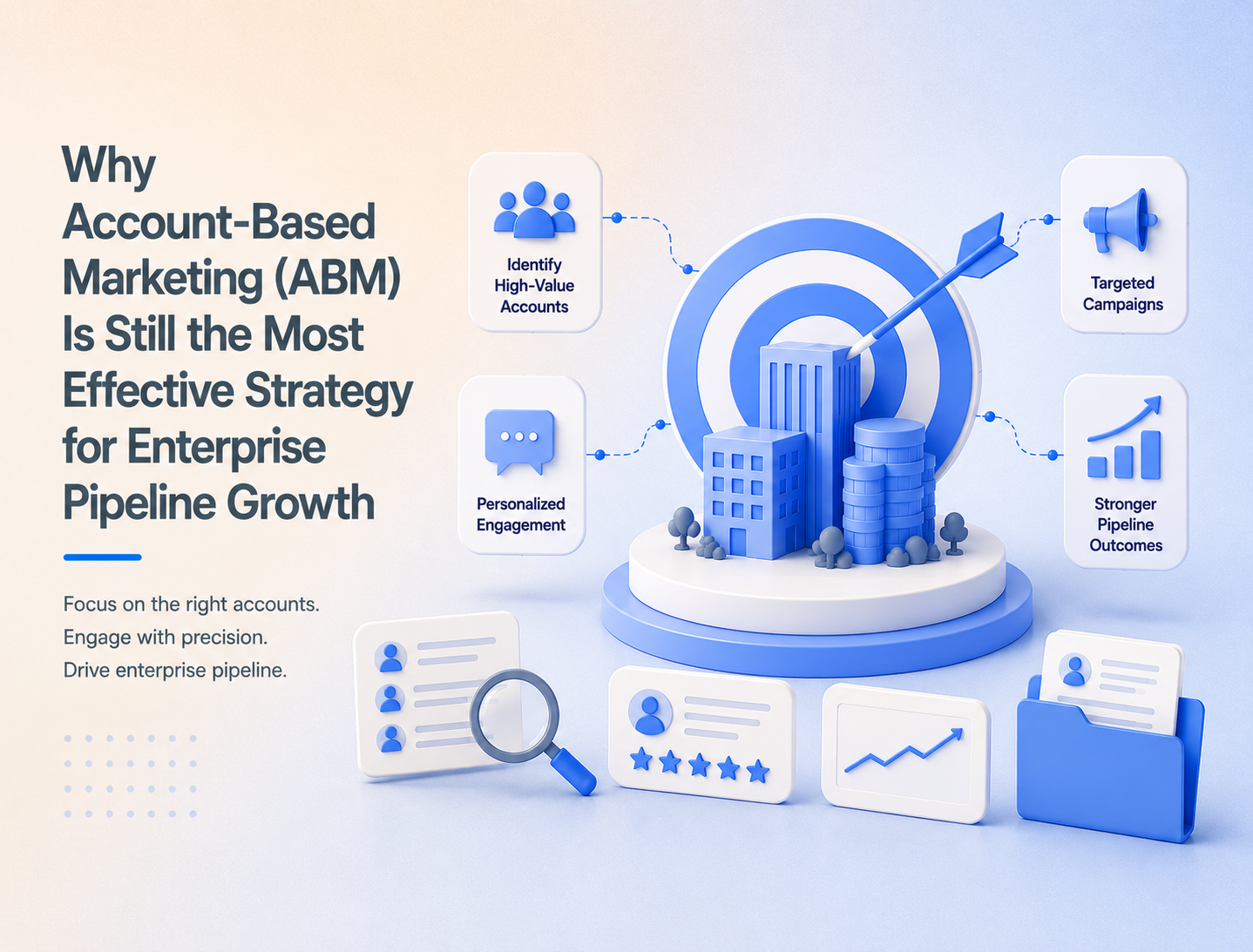
Why Account-Based Marketing (ABM) Is Still the Most Effective Strategy for Enterprise Pipeline Growth
Account-Based Marketing (ABM)


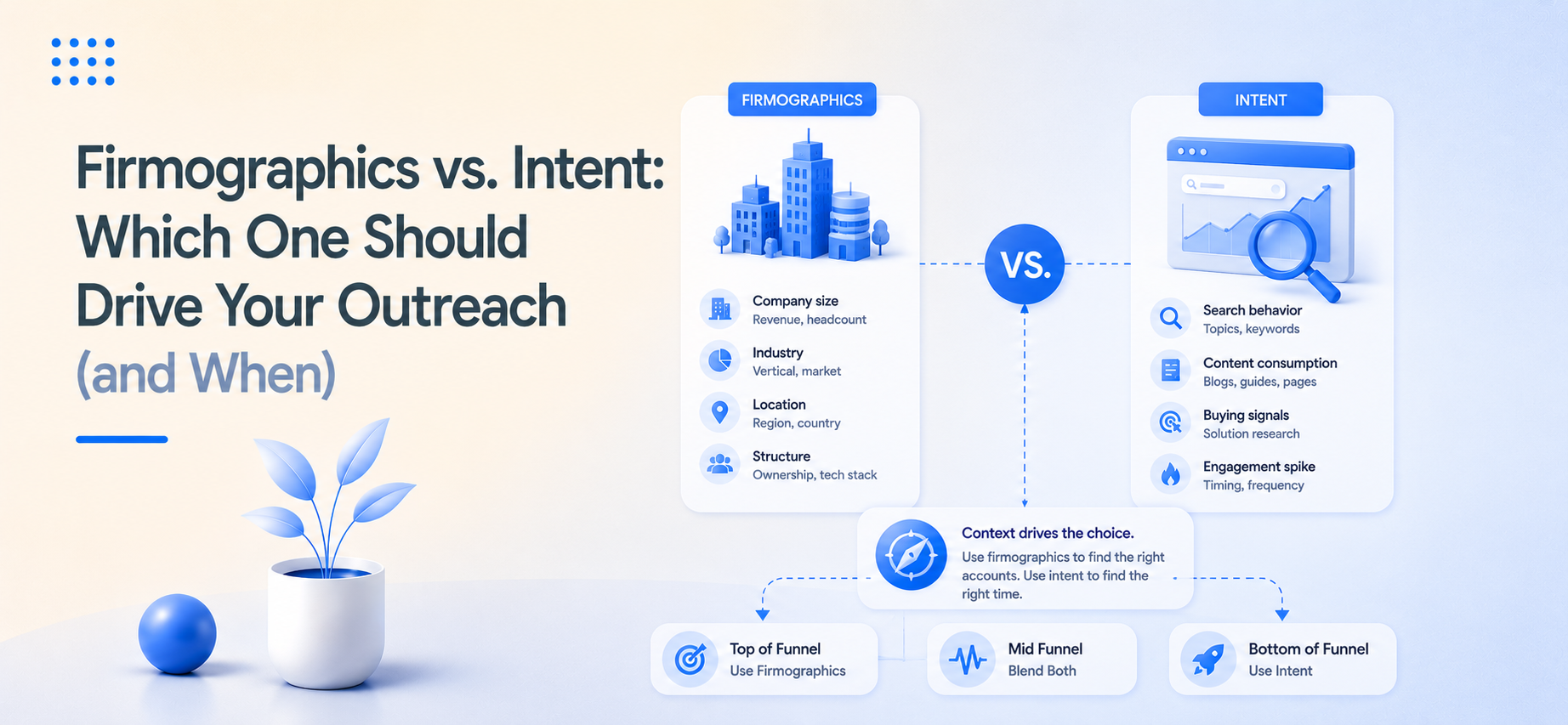
Firmographics tell you who is a fit. Intent data hints at when they might care. This post breaks down when each signal should drive outreach—and how enterprise teams combine both to convert targeting into meetings that actually happen.
-
Demand Generation
Introduction
If your outreach program feels like it’s either too broad to convert or too “timed” to scale, you’re probably over-indexing on one signal.
Firmographics and intent data are both useful—but they do different jobs. Firmographics help you avoid wasting time on accounts that were never going to buy. Intent helps you avoid reaching out at the wrong moment with the wrong message. Most enterprise demand gen teams get into trouble when they treat one as a replacement for the other.
Here’s the practical way to think about it in 2026: firmographics set your “who,” intent influences your “when,” and your outreach program determines whether either signal turns into pipeline. If you’re accountable for revenue, the question isn’t which is “better.” It’s which should drive outreach in a given motion—and what has to be true for that outreach to result in accepted meetings.
That’s exactly where Site Ascend fits: converting the right accounts and the right moments into director+ conversations that actually happen—through pay-for-performance executive meetings, lead qualification, channel motions, and event attendee procurement.
What Firmographics Means for Demand Generation Marketers (and Other ICP Titles)
Firmographics are the hard, structural traits of a company—think company size, industry, revenue band, geography, funding stage, tech stack, growth indicators, and org model.
For demand gen leaders, firmographics are your guardrails. They answer:
In other words: firmographics help you build a targeting strategy that’s defensible. They keep you from “finding leads” that can’t ever become pipeline.
Where teams go wrong is assuming that because an account is a great fit, outreach will naturally convert. Fit helps—but it doesn’t create urgency, timing, or internal consensus.
What Intent Means for Demand Generation Marketers (and Other ICP Titles)
Intent data reflects behavior that suggests research, evaluation, or change—either at the individual or account level (depending on the source). It can include consumption of topics, competitor comparisons, solution searches, or repeated engagement patterns across a buying committee.
Intent answers a different question:
The challenge is that intent is a signal, not a commitment. Teams often treat intent like a guarantee of near-term opportunity, then get frustrated when “high-intent accounts” don’t take meetings—or when sales says the leads are “interesting, but not real.”
Intent doesn’t fail because it’s useless. It fails when it’s used as a routing shortcut instead of a prioritization layer.
Common Challenges Marketers Face
1) Fit without timing creates “great targets” that never respond
If outreach is driven by firmographics alone, you’ll build a clean list—but response rates can be inconsistent because you’re not accounting for urgency, change, or internal initiatives.
2) Timing without fit creates meetings that don’t convert
If intent drives everything, you’ll chase activity. You might get engagement, but sales acceptance suffers when the account can’t actually buy, expand, or align to your ICP.
3) Sales loses confidence in signals
When sales sees “intent” used as a label instead of a rationale, they stop trusting marketing’s prioritization. When sales sees “fit” used without a compelling trigger, they stop believing outreach is worth their time.
4) SDR time gets burned on triage instead of progress
Teams spend cycles researching, personalizing, re-routing, and following up—without a consistent system that turns signals into next steps.
5) “Lead volume” metrics mask pipeline leakage
You can hit MQL targets with either approach. But accepted conversations and second calls require tighter control: qualification, targeting, scheduling, and follow-through.



.png)

%201.png)


.png)


Solutions That Work
The real solution isn’t choosing firmographics or intent. It’s designing a motion where each signal does what it’s best at—and then operationalizing the handoff so the output is a meeting, not a dashboard.
Here’s the practical playbook we recommend—and how Site Ascend supports it.
Use firmographics to define your market (and protect focus)
Start by building a firmographic definition that your sales team agrees is worth time. This becomes your baseline list for:
Where Site Ascend helps: Our outreach is purpose-built for director-level and above targeting—so your firmographic list becomes a list you can actually work without burning SDR time.
Use intent to prioritize within fit (not replace it)
Intent is best used as a sequencing layer:
Where Site Ascend helps: We convert prioritized accounts into executive meetings (30-minute virtual conversations) and you only pay for meetings that occur—so you’re not funding “activity,” you’re funding outcomes.
Build a “meeting-ready” definition (so sales acceptance goes up)
The fastest way to stop the firmographics vs. intent argument is to define what actually counts as progress.
Instead of debating whether a signal is strong, align on what a sales-accepted conversation requires, such as:
Where Site Ascend helps: Our lead qualification program converts opt-ins and engaged leads into qualified sales meetings—so sales gets fewer “maybe” leads and more booked conversations with clarity.
Put a real follow-through layer behind events and channel
Intent spikes often happen around campaigns, partner pushes, and events. But most teams lose value because they don’t have the outbound follow-up capacity to convert attention into meetings.
Where Site Ascend helps:
Make reporting operational, not cosmetic
“Intent engaged” and “ICP fit” are not outcomes. Meetings are.
Where Site Ascend helps: Real-time reporting dashboards that connect outreach activity to meetings booked and meetings held—so you can manage toward results, not just volume.
Actionable Steps for Marketers
Use this checklist to decide what should drive outreach in each motion.
A simple decision guide: Firmographics vs. Intent
Use firmographics as the driver when:
Use intent as the driver when:
The hybrid workflow that wins
If your team can’t execute steps 3–5 with current SDR bandwidth, that’s where a pay-for-performance meeting model becomes a lever.
Comparison of Market Solutions
Most teams end up choosing between three paths. Each can work—but they break in predictable ways.
Option 1: In-house SDR + marketing ops orchestration
Why teams choose it: Full control over messaging, sequencing, and tools.
Where it breaks: SDR capacity gets swallowed by research, follow-up, and rescheduling—especially when you add events, partner motions, and multiple segments. Output becomes inconsistent, and meetings become the bottleneck.
Option 2: Intent-first automation and scoring
Why teams choose it: Feels scalable and “data-driven.”
Where it breaks: You can generate a lot of prioritized accounts, but prioritization isn’t conversion. Without a real outbound and qualification layer, you end up with more dashboards than meetings—and sales loses trust when “hot” doesn’t translate.
Option 3: Outsourced appointment setting or lead services
Why teams choose it: Faster execution and coverage.
Where it breaks: Many options optimize for volume or cost per lead—resulting in unqualified meetings, offshore delivery concerns, unclear targeting, or weak accountability for whether meetings actually happen.
Where Site Ascend is different
Site Ascend is designed for enterprise demand gen teams who want outcomes without the usual tradeoffs:
Conclusion
Firmographics and intent aren’t competing strategies—they’re complementary signals. Firmographics protect focus. Intent improves timing. But neither one creates pipeline on its own unless you have an execution layer that converts signal into a booked, attended conversation with the right level of buyer.
If you want to turn fit + intent into meetings that happen—without burning SDR time—pilot Site Ascend’s executive meeting or lead qualification programs and measure success the only way that matters: sales-accepted conversations that move to next steps.
Should firmographics or intent drive lead routing?

Why do “high-intent” accounts still ignore outreach?
How do we operationalize firmographics + intent without creating a messy handoff to sales?


Start your pilot campaign today and explore the full range of Site Ascend's demand generation capabilities. Experience firsthand how we can enhance your efficiency, streamline your processes, and drive growth.
RELATED