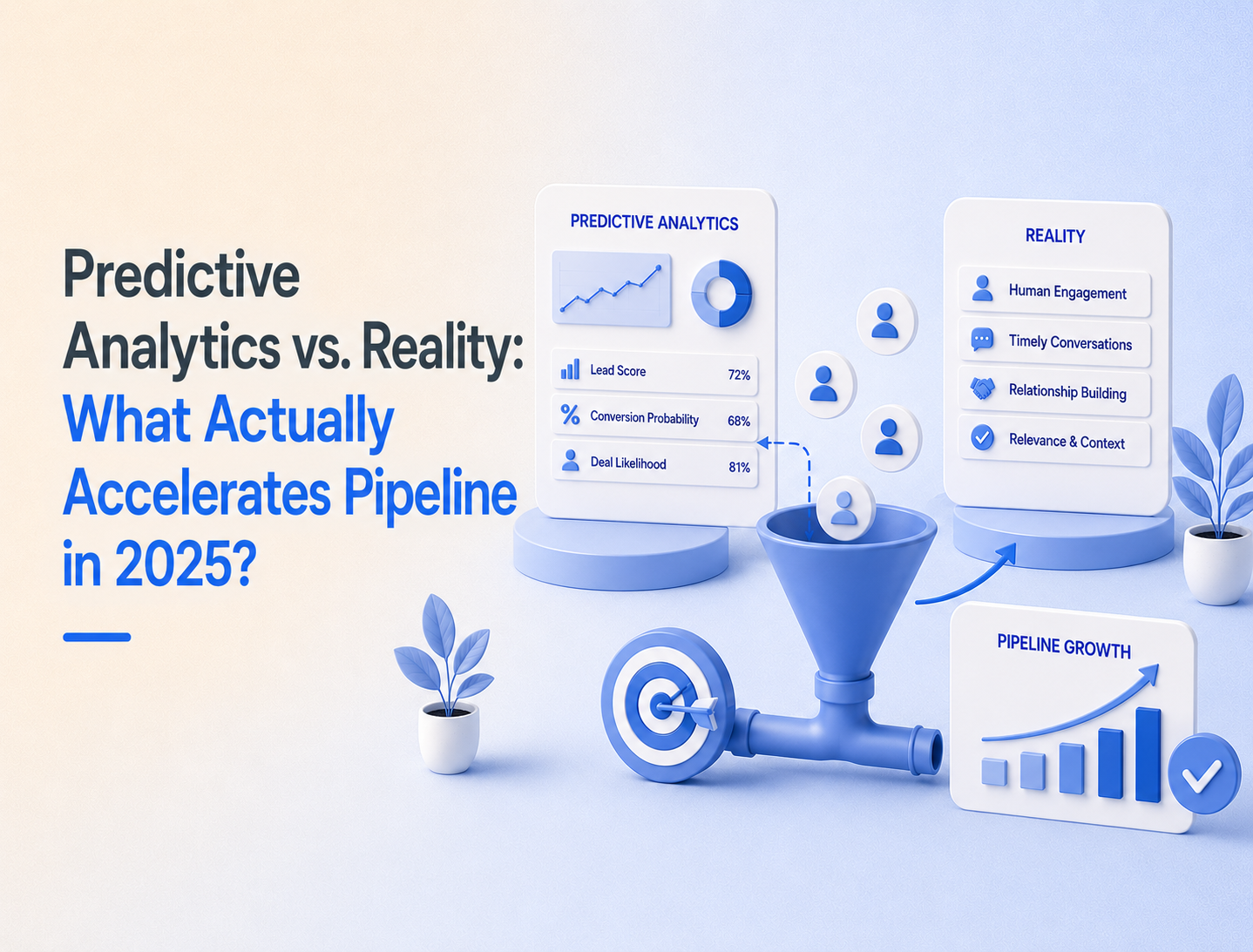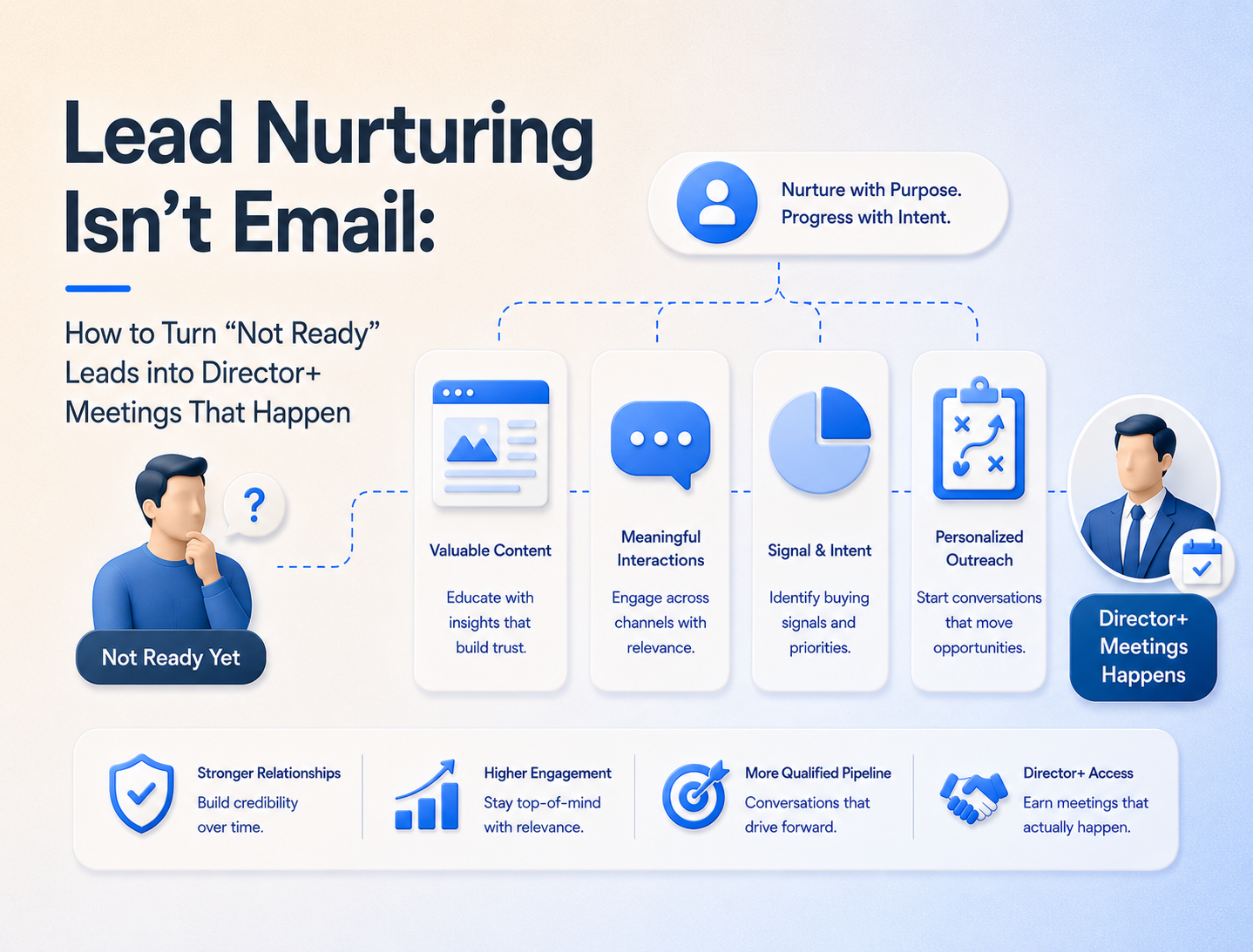
Lead Nurturing Isn’t Email: How to Turn “Not Ready” Leads into Director+ Meetings That Happen
Demand Generation


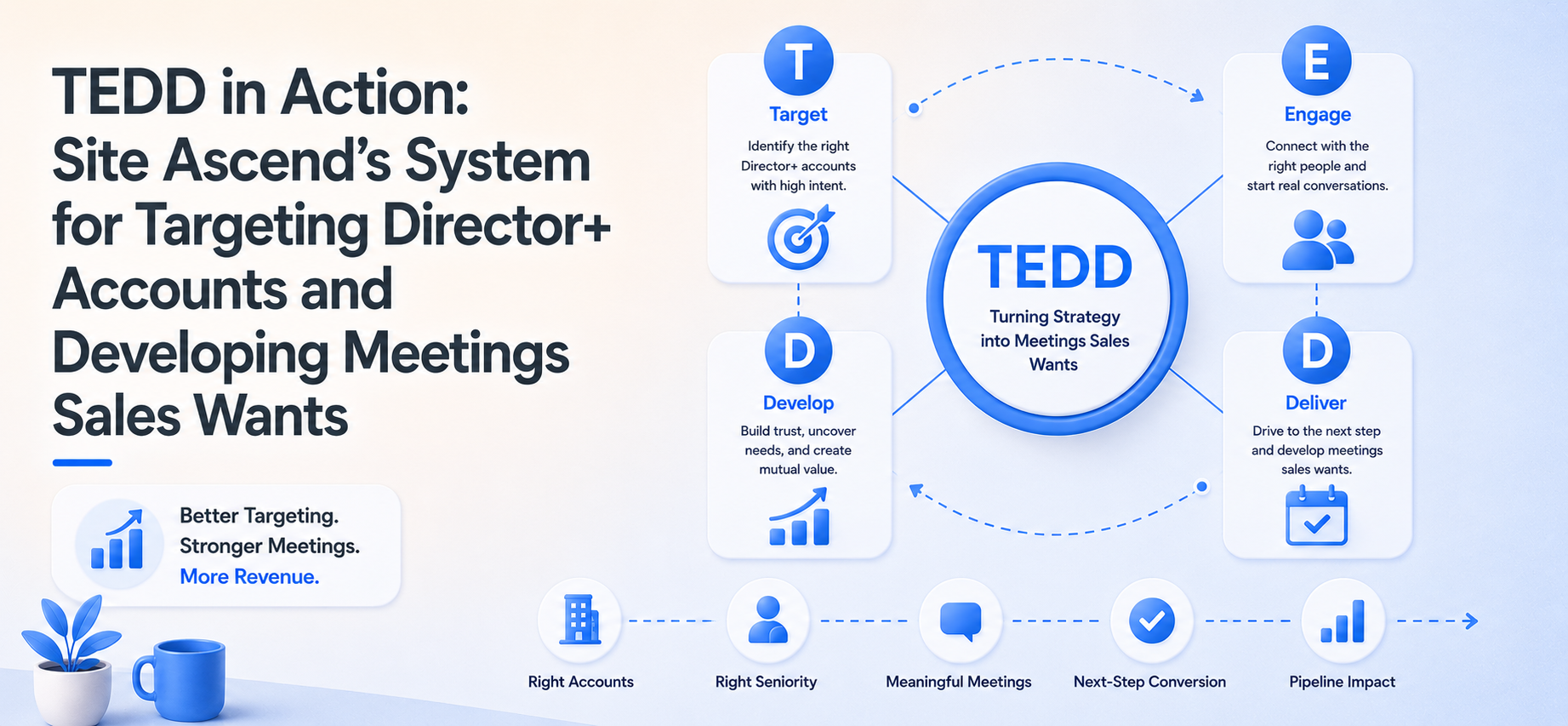
TEDD (Target, Engage, Discover, Develop) is a practical system for turning demand gen activity into Director+ meetings that actually happen—and advance. See how Site Ascend applies TEDD across executive meetings, channel MDF programs, event attendee procurement, and opt-in lead qualification to improve show rates, meeting quality, and next-step conversion.
-
Demand Generation
Introduction
Most demand gen teams don’t have an “activity” problem.
They have a conversion problem—where perfectly reasonable programs (events, partner MDF, content opt-ins, outbound) generate motion… but not enough Director+ conversations that actually happen and progress to next steps.
That gap shows up in familiar ways:
TEDD (Target, Engage, Discover, Develop) is a practical framework for fixing that. Not as theory—as an execution system.
And it maps directly to how Site Ascend runs demand gen programs built around four outcomes:
What TEDD means for demand generation marketers (and Site Ascend’s ICP)
Think of TEDD as a meeting-quality operating system. Each stage prevents a common failure mode:
Target
Define who belongs in the pipeline conversation.
Engage
Create response and attendance—not just clicks.
Discover
Capture the context sales needs to convert.
Develop
Turn a scheduled meeting into forward motion.
For enterprise demand gen leaders (CMOs, VPs/Directors of Demand Gen, ABM, Field, Channel, Revenue Marketing), TEDD is less about “qualifying leads” and more about engineering consistent, sales-usable conversations.
Common challenges marketers face
1) “Target” breaks when ICP isn’t enforced at the meeting level
Even strong targeting models fail if the meeting itself doesn’t meet a standard:
Result: sales loses confidence and stops treating marketing-sourced meetings seriously.
2) “Engage” breaks when programs optimize for volume, not commitment
Registrations, responses, and booked slots can be misleading.
Result: show rates drop and pipeline math collapses.
3) “Discover” breaks when context is missing
Sales can’t convert a meeting if they don’t know:
Result: the meeting becomes a generic intro and dies quietly.
4) “Develop” breaks when there’s no system between “booked” and “progressed”
A meeting isn’t a result. It’s a step.
Without a development layer, you get:
Result: marketing reports meetings; sales reports “nothing came from it.”



.png)

%201.png)


.png)


Solutions that work
Here’s how Site Ascend operationalizes TEDD across the programs demand gen teams lean on most.
1) Executive Meetings: TEDD built for Director+ conversations that happen
Target: Site Ascend targets Director-level and above stakeholders, which changes meeting quality immediately. Director+ audiences are more likely to:
Engage: Outreach is designed around commitment, not just curiosity—paired with a model where you only pay for meetings that occur, which naturally forces attention on attendance and quality.
Discover: The meeting is positioned to surface context that sellers can use—what’s happening, what’s driving interest, and what would make the meeting worth the time.
Develop: The goal isn’t “book the call.” It’s “book the call that advances.” That means:
Why this matters for demand gen: it turns “meeting volume” into a defensible performance metric because it’s tethered to seniority and attendance—not just booking activity.
2) Channel Marketing: TEDD turns MDF into measurable outcomes (white-labeled)
Channel leaders live with an uncomfortable truth: MDF often funds activity that’s hard to defend.
Site Ascend’s Channel Marketing approach uses white-labeled outreach to produce meetings on behalf of partners—funded by MDF—so the output becomes conversations, not just campaigns.
Target: TEDD starts by aligning partner motion to the right accounts and Director+ personas. That helps avoid MDF waste where:
Engage: White-labeled outreach reduces friction because partners can activate under their brand while you maintain a consistent execution standard.
Discover: Capturing basic context is the difference between a partner “intro” and a partner meeting that advances.
Develop: When MDF is tied to meetings that occur, the program naturally emphasizes confirmation and attendance—not just passing names.
The big win: demand gen and channel teams can defend MDF spend with outcomes that sales and finance recognize.
3) Event Marketing: TEDD applied to attendee procurement (not day-of event services)
Events fail when teams optimize for registrants instead of right-fit registrants who show up.
Site Ascend’s Event Marketing focuses on driving registrations via outbound dialing, then supporting attendance with an SMS workflow through the event date. (Important scope note: Site Ascend does not provide day-of onsite event services.)
Target: Events work best when you define:
Engage: Outbound dialing is built for high-intent engagement—especially for niche audiences where email-only promotion can inflate registrations without commitment.
Discover: Even pre-event, you can capture meaningful context:
Develop: SMS support reduces the friction between “registered” and “attended”—which is often where event ROI disappears.
Net effect: better-fit attendance, stronger post-event follow-up conversations, and fewer “we got a list” outcomes.
4) Lead Qualification: TEDD converts opt-ins into sales-ready meetings
Opt-in leads are valuable—but only when you can distinguish:
This is where TEDD makes lead qualification actually useful.
Target: Define which opt-ins are even eligible for conversion (title floor, account fit, relevance).
Engage: Use human outreach to create response and confirm intent—especially when forms and scoring can’t tell you timing or urgency.
Discover: Capture what sales needs: reason for interest, pain points, timeline, stakeholders.
Develop: Convert the right leads into meetings that occur—with enough context that sales treats them as worth running.
For demand gen, this reduces the “marketing passed junk” narrative and improves conversion without asking SDR teams to carry all the follow-up load.
Actionable steps for marketers
Here’s a practical TEDD checklist you can apply immediately to improve meeting quality across programs.
The TEDD Demand Gen Checklist
1) Target (define meeting-level ICP)
2) Engage (optimize for commitment)
3) Discover (standardize what context must be captured)
Minimum required fields for any “qualified meeting”:
4) Develop (make the meeting advance)
Track three weekly metrics:
If any of these are weak, the fix is usually a TEDD stage—not “more volume.”
Comparison of market solutions
You don’t need a vendor bake-off to understand the tradeoffs. Most teams choose between these models:
In-house SDR/BDR teams
Strengths: tight control, direct alignment to sales.
Tradeoffs: ramp time, turnover, inconsistent execution when priorities shift.
TEDD works well here if you can enforce it consistently across reps and maintain quality under pressure.
Outsourced appointment setting (volume-first)
Strengths: fast coverage, scalable outreach.
Tradeoffs: incentives can favor quantity (leads/bookings) over meeting attendance and context.
TEDD breaks down when “Engage” and “Develop” aren’t accountable to meetings that occur.
Channel/MDF programs optimized for activity
Strengths: easy to launch, easy to report.
Tradeoffs: hard to attribute, inconsistent follow-up, limited pipeline defensibility.
TEDD requires MDF to tie to outcomes—especially meetings and meeting quality.
Event models focused on day-of execution
Strengths: onsite energy, experiential impact.
Tradeoffs: doesn’t solve who attends or what happens after without a strong procurement and conversion system.
TEDD helps when events are treated as a pipeline motion, not just a brand motion.
Why Site Ascend tends to fit TEDD-driven teams
Site Ascend’s differentiators map directly to TEDD execution discipline:
Conclusion
If your demand gen programs generate activity but not enough Director+ meetings that happen and advance, TEDD is the simplest way to diagnose the breakdown—and fix it.
If you want to operationalize TEDD with a partner built around meeting outcomes (not volume), reach out to Site Ascend to discuss a pilot across executive meetings, channel MDF motions, event attendee procurement, and/or lead qualification.
Is TEDD just another qualification framework?

Which demand gen motion benefits most from TEDD?
How do you pilot TEDD without rebuilding the team?


Start your pilot campaign today and explore the full range of Site Ascend's demand generation capabilities. Experience firsthand how we can enhance your efficiency, streamline your processes, and drive growth.
RELATED