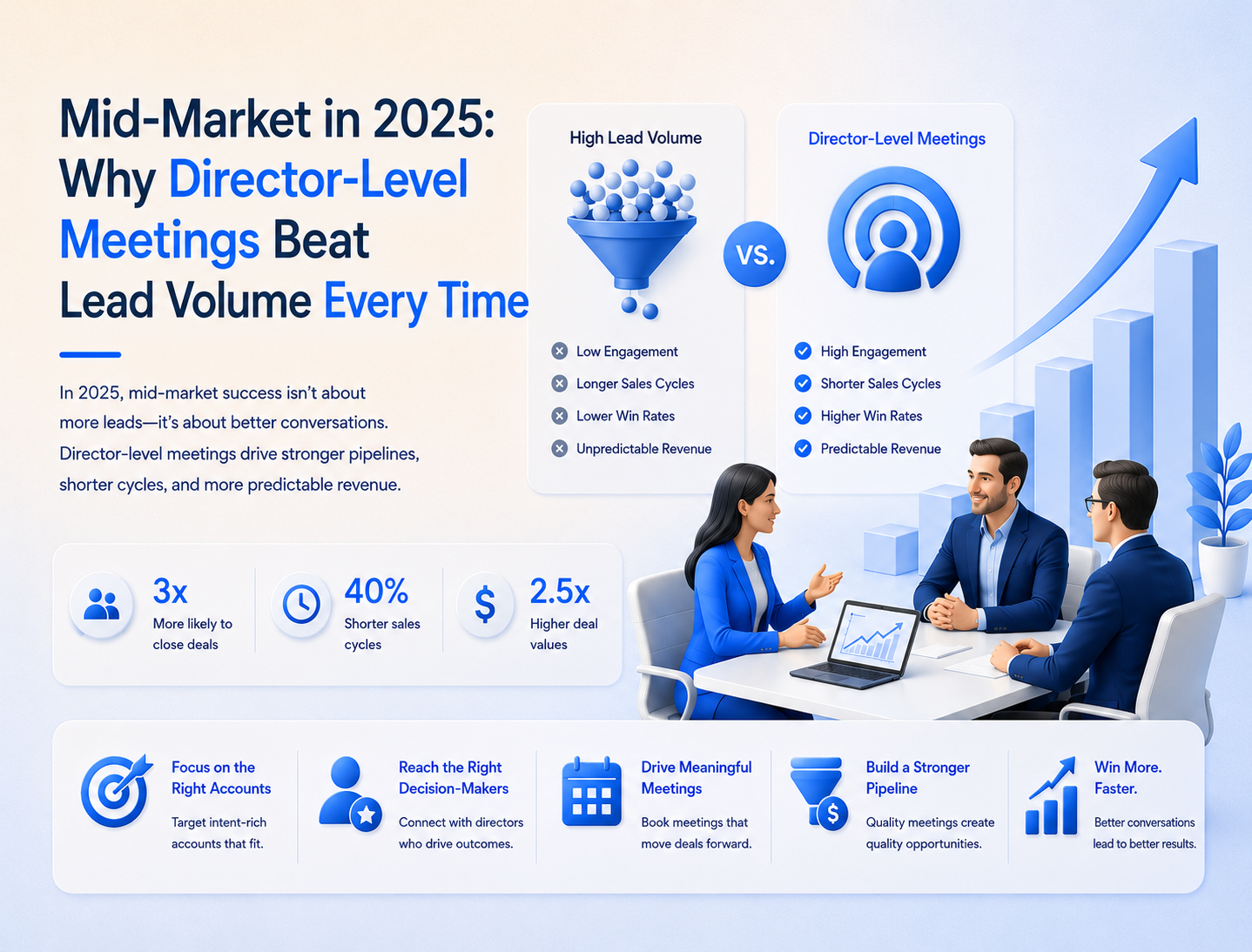
Mid-Market in 2025: Why Director-Level Meetings Beat Lead Volume Every Time
Demand Generation Strategy


Top-of-funnel engagement is easy to celebrate—and even easier to misread. Clicks, downloads, and registrations can signal interest, but they rarely translate into pipeline without a deliberate conversion motion behind them. This post breaks down what has to happen after TOFU: how to qualify early interest, create clean handoffs, and convert marketing responses into sales-accepted meetings that actually occur.
-
Demand Generation
Introduction
Top-of-funnel (TOFU) performance is one of the easiest places to “win” on a dashboard—and one of the easiest places to lose revenue quietly.
A spike in clicks, downloads, webinar signups, or booth scans can look like momentum. But most enterprise demand gen leaders have lived the same sequel: sales rejects the leads, SDRs burn cycles chasing the wrong people, and the “campaign that crushed it” produces little to no pipeline.
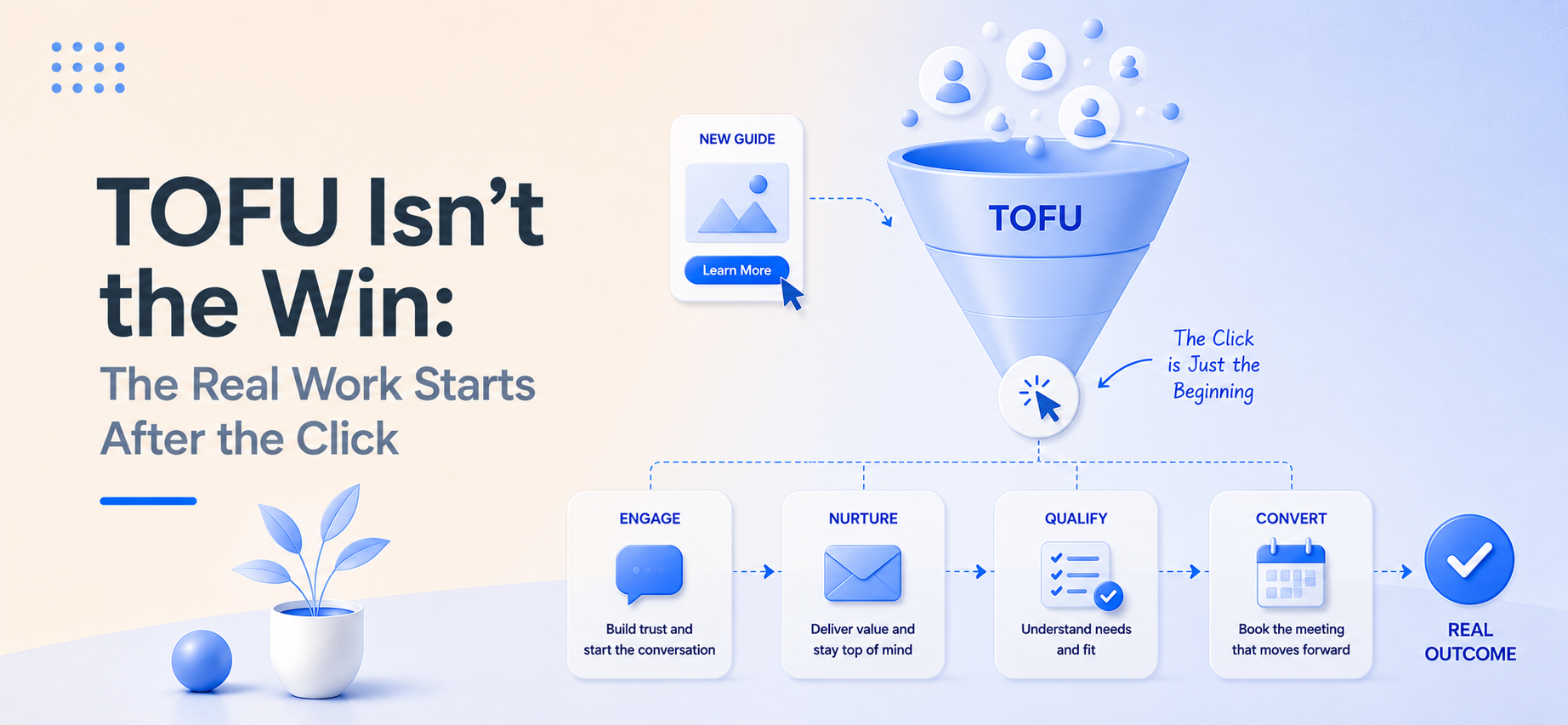
The issue isn’t that TOFU is bad. The issue is that TOFU is incomplete. The real work starts after the click—when you translate attention into a next step sales accepts.
This is where Site Ascend fits: turning response into real conversations through executive meeting programs, lead qualification, event attendee procurement, and channel marketing motions built around outcomes—not activity.
What TOFU Means for Demand Generation Marketers (and Site Ascend’s ICP)
TOFU (Top-of-Funnel) is the stage where a buyer first signals awareness or curiosity. In B2B tech, that typically includes:
For demand gen leaders, TOFU has three practical jobs:
TOFU does job #1 well. Most teams struggle with #2 and #3, especially when the ICP requires director+ stakeholders and the buying committee is distributed.
Common Challenges Marketers Face
TOFU breaks down when the funnel assumes that interest equals readiness. In enterprise demand gen, four failure points show up repeatedly:
1) Response comes from the wrong person
You get a form fill—but it’s a student, a junior practitioner, a consultant, or someone outside the buying path. Even if the account is right, the contact isn’t.
2) You can’t operationalize speed-to-lead
Even strong inbound signals decay quickly when follow-up is delayed, inconsistent, or routed incorrectly. When no one owns the first 24–72 hours, TOFU turns into stale backlog.
3) Handoffs create friction
Sales doesn’t trust the “MQL,” SDRs don’t trust the data, and marketing doesn’t trust the outcome. When the definition of “qualified” is ambiguous, the handoff becomes a negotiation instead of a motion.
4) Activity gets measured instead of outcomes
Teams optimize for volume (registrations, clicks, leads) because it’s measurable—then realize too late that none of it produced meetings, opportunities, or pipeline movement.



.png)

%201.png)


.png)


Solutions That Work
If TOFU is the signal, your conversion engine is the system that proves the signal is real.
Here’s a practical enterprise model that aligns with what Site Ascend delivers: turn TOFU into sales-accepted next steps using a conversion layer that prioritizes role, relevance, and commitment.
1) Add a qualification layer that protects sales time
The fastest way to improve funnel efficiency isn’t more leads—it’s fewer wrong leads.
Site Ascend’s Lead Qualification program is built to convert opt-in responses (like downloads or event registrations) into qualified meetings by validating:
This is how you reduce “lead risk”—the gap between what marketing captured and what sales can actually work.
2) Convert interest into conversations via meeting-first programs
If the goal is pipeline, the unit of value can’t be “a lead.” It has to be a meeting that occurs.
Site Ascend’s Executive Meetings program focuses on booking 30-minute virtual meetings with director+ stakeholders in target accounts—built for enterprise realities (multiple stakeholders, longer cycles, and higher bars for relevance). You get:
3) Make events measurable beyond registration
For event teams, TOFU often looks like registration volume. But pipeline depends on what happens next: confirmation, attendance, and post-event conversion.
Site Ascend’s Event Marketing program focuses on attendee procurement via outbound dialing, then supports registrants through SMS workflows up to the event date. The goal is simple: increase the percentage of registrants who actually show up—and who can take a next step afterward.
(And to be explicit: Site Ascend does not provide day-of-event onsite services. The focus is driving registrants and attendance through outbound + SMS support.)
4) Use channel motions without channel conflict
Partner and channel campaigns often generate TOFU—then stall due to unclear ownership.
Site Ascend supports Channel Marketing through white-labeled appointment setting on behalf of partners, funded through MDF where applicable. This allows you to:
Actionable Steps for Marketers
Use this checklist to turn TOFU into sales-accepted next steps—without flooding sales with noise.
A TOFU-to-Meeting Conversion Checklist (Enterprise Edition)
If you want this operationalized quickly, a pilot with Site Ascend typically starts by selecting one TOFU source (content opt-ins, event registrations, partner leads) and converting it into meetings through qualification + outreach, with outcome-based reporting.
Comparison of Market Solutions
Most teams choose one of three approaches for TOFU conversion. Here’s what they look like in practice—and where they tend to break.
Example 1: The Procurement View
Outcome 1: Predictable, auditable performance
Outcome 2: Lower risk per dollar spent
Outcome 3: Internal bandwidth protection
Conclusion
TOFU isn’t the win. It’s a starting point.
If your funnel stops at clicks and form fills, you’re collecting attention—not building pipeline. The enterprise teams that consistently generate revenue from TOFU do three things well: they validate the right stakeholders, they create clean handoffs, and they optimize for meetings that occur—not lead volume.
If you want to turn TOFU signals into sales-accepted next steps without burning SDR time, Site Ascend can help you pilot a conversion motion built around outcomes: executive meetings, lead qualification, event attendee procurement, and partner/ channel appointment setting.
Ready to convert TOFU into meetings that happen? Contact Site Ascend to start a pilot.
What’s the difference between a TOFU lead and a sales-accepted opportunity?

Why does sales reject “good” TOFU leads?
How do you prevent SDR teams from burning time on TOFU follow-up?


Start your pilot campaign today and explore the full range of Site Ascend's demand generation capabilities. Experience firsthand how we can enhance your efficiency, streamline your processes, and drive growth.
RELATED