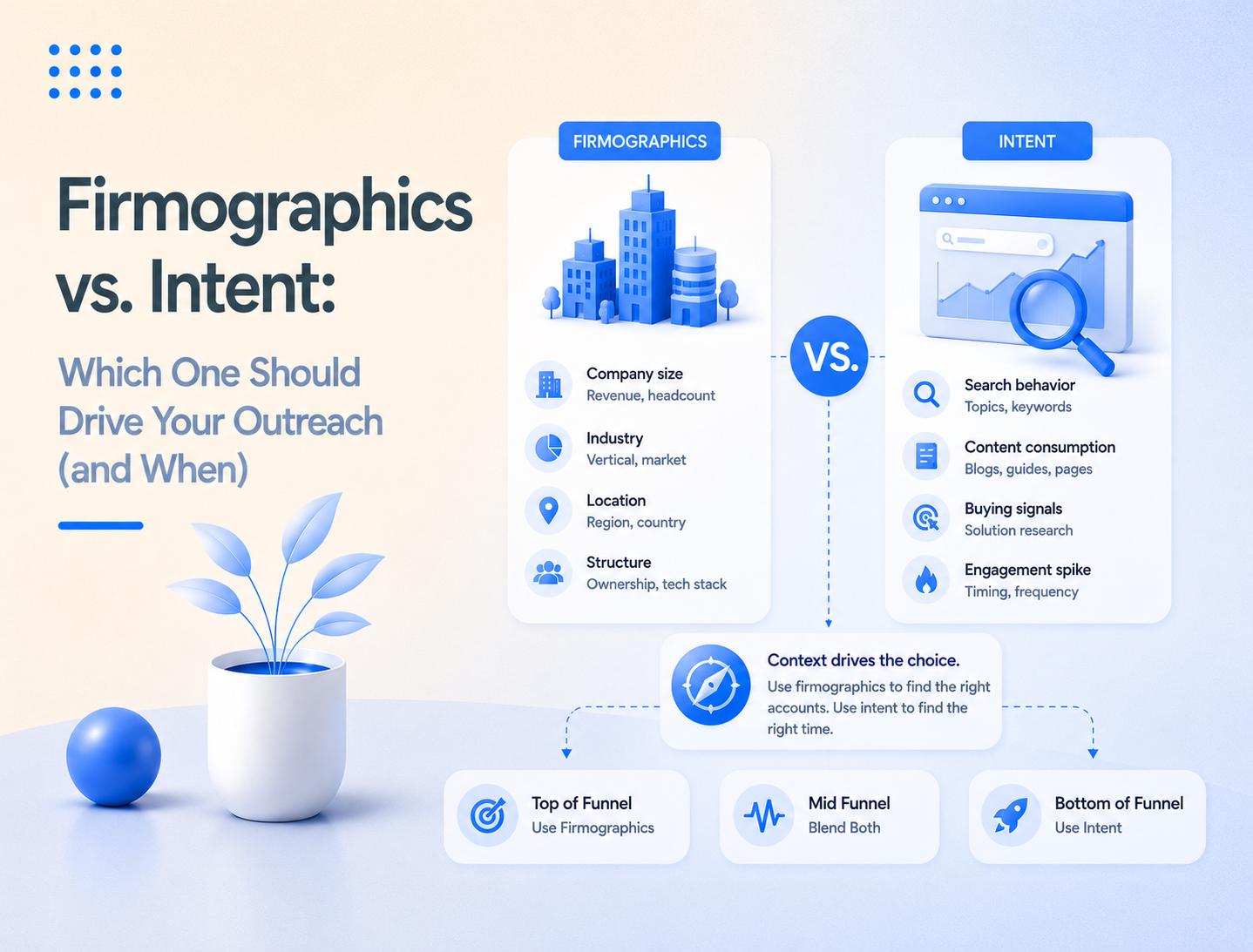
Firmographics vs. Intent: Which One Should Drive Your Outreach (and When)
Demand Generation


MQLs measure engagement—MALs prove sales-worthiness. This blog explains why enterprise demand gen teams use Marketing Accepted Leads to verify authority, need, and urgency before handoff, and how Site Ascend operationalizes MAL to drive Director+ meetings that occur and convert into next steps.
-
Demand Generation
Introduction
If you’ve led demand gen in enterprise tech, you’ve probably had a quarter where everything looked “healthy” on paper:
…and yet pipeline didn’t move the way it should.
That’s the MQL problem in one sentence: engagement is not readiness.
Most organizations don’t actually need more leads. They need a better filter between “someone interacted with marketing” and “sales should spend time here.”
That filter is MAL.
MAL (Marketing Accepted Lead) is the stage where marketing says:
“We’ve done enough work to confirm this is worth a sales conversation.”
For enterprise demand gen teams, MAL often beats MQL because it forces what modern buying committees require: stakeholder relevance, real need, timing, and a path to a next step—not just activity.
This blog breaks down what MAL means, why it outperforms MQL as a quality standard, and how Site Ascend helps operationalize MAL through Lead Qualification and Executive Meetings designed to produce Director+ meetings that occur and advance.
What MAL means for demand generation marketers (and why it matters)
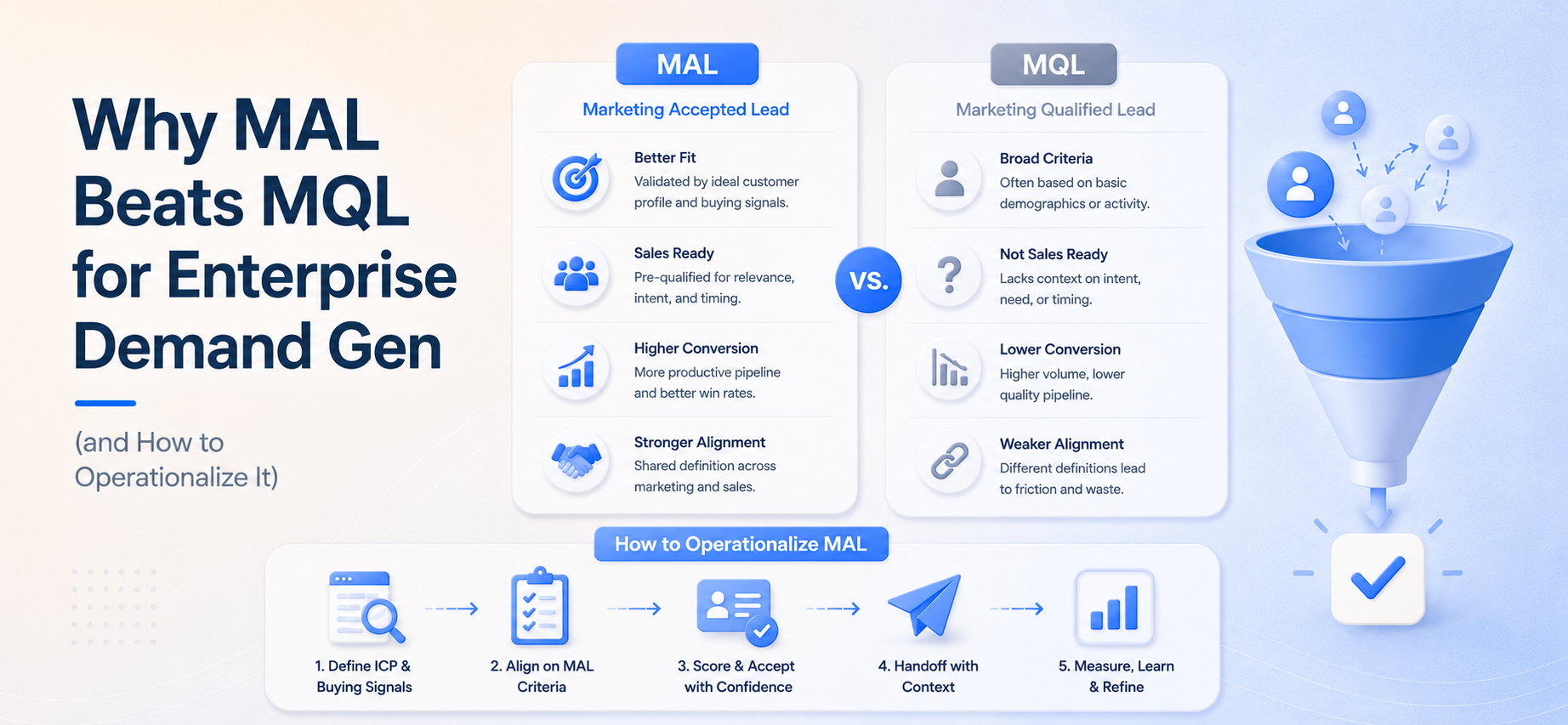
An MQL is typically defined by signals:
A MAL is defined by verification:
In other words:
MQL = “They engaged.”
MAL = “They’re worth a conversation.”
For enterprise tech demand gen, MAL is powerful because it creates a shared language with sales. You stop arguing about lead score thresholds and start aligning on what makes a lead actionable.
Common challenges marketers face
MQLs create volume without confidence
When teams optimize to MQL targets, thresholds tend to loosen over time. The result is a growing pool of “qualified” leads that sales treats like noise.
Seniority mismatch slows everything down
Enterprise buying committees form around authority. If the “lead” is too junior, sales has to do extra work just to reach someone who can sponsor a next step.
Timing is unclear, so follow-up becomes optional
A lead can be a great fit and still be too early. Without a trigger (renewal, mandate, initiative kickoff, deadline), sellers prioritize other accounts.
Need gets assumed from interest
Enterprise buyers often consume content for internal education. MQL logic can interpret that as intent. MAL requires you to confirm whether there’s an actual problem worth solving.
Meetings get booked—but they don’t hold, or they don’t progress
Even when MQLs become meetings, you can lose ROI quickly if:



.png)

%201.png)


.png)


Solutions that work
MAL becomes valuable when it’s implemented as a system, not a new acronym.
For enterprise demand gen teams, the easiest way to operationalize MAL is to standardize what marketing confirms before sales engages—and to use service motions that can consistently capture that context.
Lead Qualification: turning opt-ins into MALs that sales will actually work
Site Ascend’s Lead Qualification program is built for a simple outcome: convert opt-in engagement into qualified meetings only when there’s enough truth to justify sales time.
How that supports MAL:
Stakeholder relevance
Problem clarity
Urgency
Meeting readiness
That MAL discipline reduces the most common enterprise failure mode: sales doesn’t believe marketing’s “qualified” label.
Executive Meetings: using “meetings that occur” as the MAL proof point
If MAL is marketing accepting responsibility for lead readiness, the cleanest proof is meetings that occur—especially with decision-relevant stakeholders.
Site Ascend’s Executive Meetings are designed around:
For demand gen leaders, this is one of the most defensible ways to show MAL performance because it converts “accepted lead” into a measurable revenue-ready event:
Where channel and events fit (only when MAL is your standard)
If your organization measures partner programs and events as pipeline motions, MAL can be the difference between “activity” and “outcome.”
Site Ascend supports event attendee procurement via outbound dialing and uses SMS workflows leading up to the event date (not day-of services). That structure is designed to improve attendance quality and post-event conversion.
Actionable steps for marketers
Here’s a practical MAL operating guide you can implement without ripping out your funnel.
The MAL Operating Standard
Define MAL as “sales-worthy,” not “marketing-engaged.”
A lead becomes a MAL when marketing can confirm the following:
Authority signal
Need signal
Urgency signal
Plausibility signal
Next-step signal
The MAL checklist (fast version)
The three metrics that prove MAL quality weekly
When these move, you’re not just improving lead quality—you’re improving pipeline probability.
Comparison of market solutions
Here’s the market landscape through a procurement lens—how organizations evaluate solutions for improving lead quality and meeting outcomes.
Lowest cost per activity
What you’re buying: volume of attempts (dials, touches) or raw lead counts.
Why teams choose it: unit economics look great.
Where it breaks: incentives favor activity over verification, so MAL discipline is weak and sales trust erodes.
Predictable volume
What you’re buying: guaranteed lead quantities, registrations, or booked meetings.
Why teams choose it: forecasting feels easier.
Where it breaks: volume doesn’t guarantee seniority, urgency, or held-meeting outcomes—so MQLs inflate and MAL doesn’t exist in practice.
Defensible pipeline impact
What you’re buying: outcomes that map to revenue reality—meetings that occur, stakeholder relevance (Director+), and measurable next-step conversion.
Why teams choose it: it aligns to sales behavior and finance scrutiny.
Why Site Ascend fits: lead qualification that verifies readiness, executive meetings targeted to Director+ stakeholders, accountability to meetings that occur, U.S.-based execution, and real-time reporting visibility.
Conclusion
Enterprise demand gen doesn’t fail because teams can’t generate engagement. It fails when engagement gets mislabeled as readiness.
MAL beats MQL because it turns “they interacted” into “sales should act”—by verifying:
If your team wants to stop arguing about lead quality and start proving ROI with meetings that occur—especially with Director+ stakeholders—contact Site Ascend to pilot a MAL-based motion using:
What’s the difference between an MQL and a MAL?

Does MAL replace MQL?
How do we implement MAL without slowing the funnel?


Start your pilot campaign today and explore the full range of Site Ascend's demand generation capabilities. Experience firsthand how we can enhance your efficiency, streamline your processes, and drive growth.