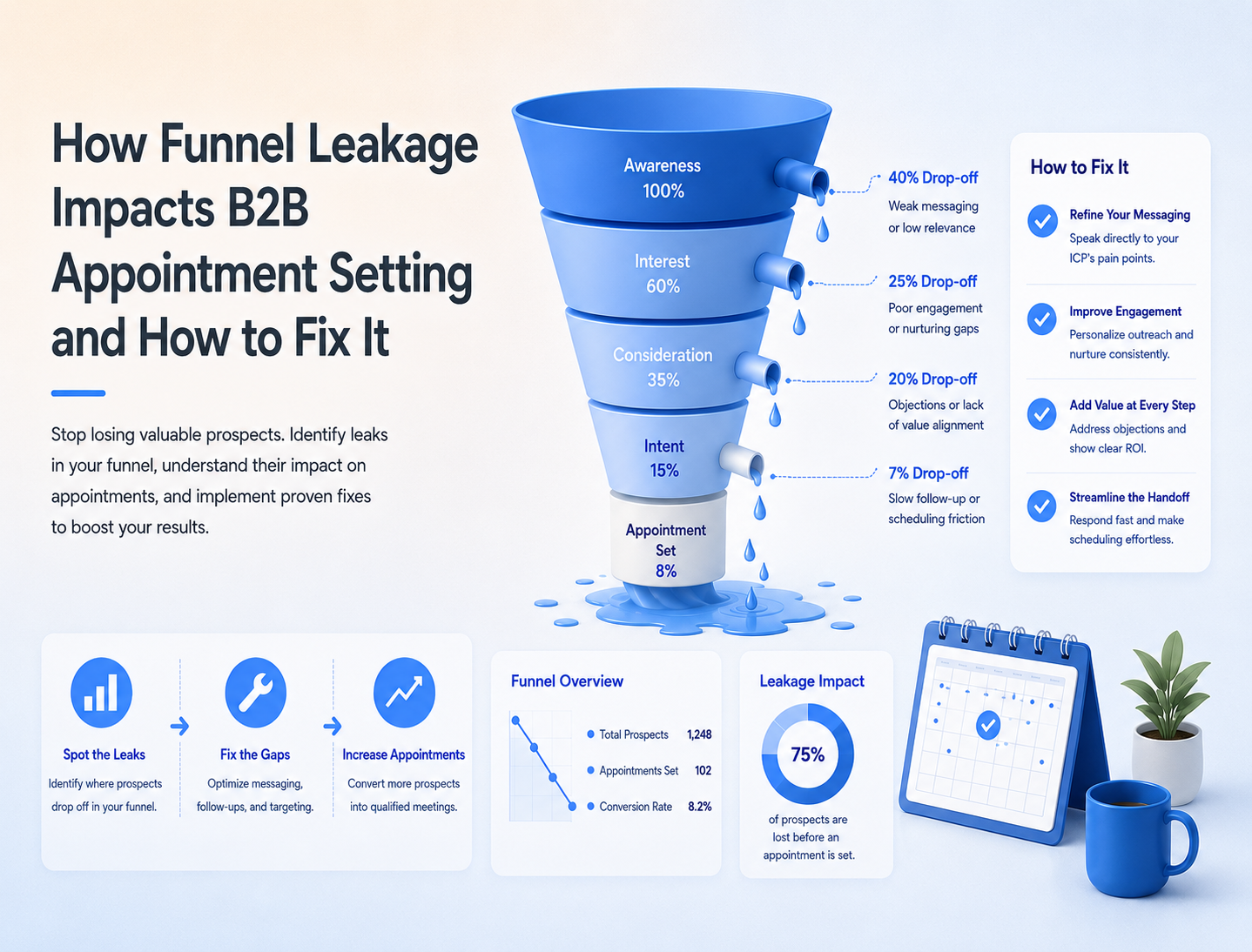
How Funnel Leakage Impacts B2B Appointment Setting and How to Fix It
B2B Appointment Setting


Enterprise pipeline often breaks quietly—through lead leakage at capture, routing, handoff, qualification, meeting hold rates, and next-step conversion. This guide shows how to spot the six most common leaks, audit drop-off by stage, and reduce waste with clearer actionability, Director+ focus, and meetings that occur.
-
Pipeline Conversion
Introduction
Enterprise demand gen rarely fails in dramatic ways.
It fails quietly.
You hit your lead goals. Dashboards look fine. Engagement is steady. But pipeline doesn’t move the way it should—and when you look back, it’s hard to pinpoint what went wrong. Nothing looks “broken.” It just feels like gravity.
That’s lead leakage.
Not “bad leads.” Not “sales didn’t follow up.” Not “marketing didn’t drive enough volume.” Lead leakage is the slow loss of conversion potential as leads pass through handoffs, queues, and calendar invites.
And the higher the ACV, the more expensive leakage becomes—because enterprise pipeline is built on a small number of high-value conversations, often with Director+ stakeholders.
This post maps the most common leakage points in enterprise demand gen and shows how Site Ascend helps plug them by converting engagement into qualified sales meetings and Director+ meetings that occur.
What Lead Leakage Means for Demand Generation Marketers and other titles that meet Site Ascend’s ICP
Lead leakage is the gap between what should convert and what actually converts—not because the lead was unqualified, but because the system around the lead couldn’t carry it forward.
In practice, leakage shows up as:
If you’re measuring lead volume and stage velocity without measuring drop-off, you can miss leakage for months.
Common Challenges Marketers Face
Lead leakage is often blamed on a single team. In reality, it’s usually a chain reaction.
A few patterns show up over and over:
These aren’t “tactics.” They’re structural.
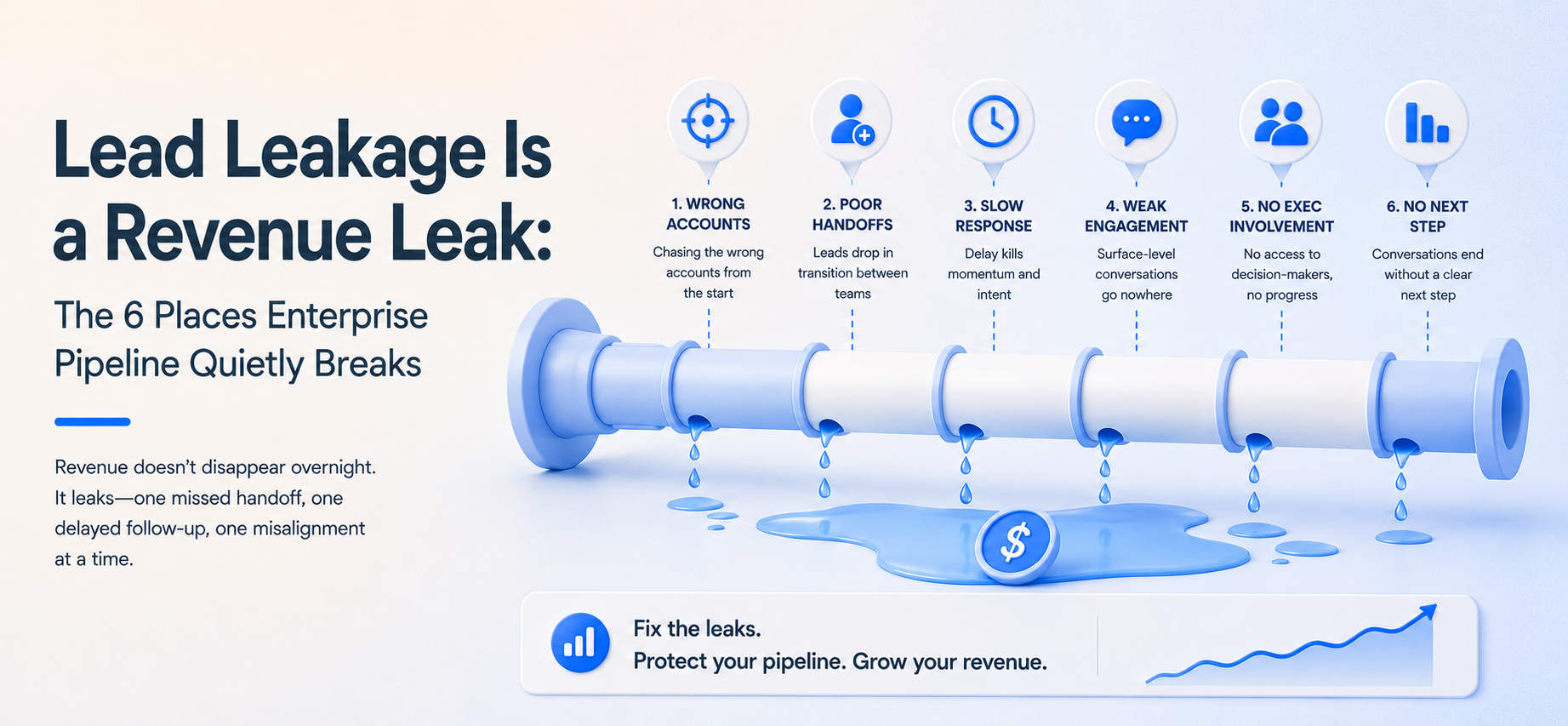
The 6 Places Enterprise Pipeline Quietly Breaks
1) Capture leakage: the lead is real, but the moment is fragile
The highest-intent window is often the shortest: right after a form fill, event registration, or inbound action.
Leakage happens when:
By the time sales engages, the initiative has cooled—or another vendor has already shaped the conversation.
2) Routing leakage: “assigned” doesn’t mean “owned”
Routing rules can be perfect and still produce leakage.
Common causes:
3) Handoff leakage: the record moves, the story doesn’t
Handoffs often transfer fields instead of meaning.
Sales needs a short narrative:
Without that, leads become “accepted but ignored,” or they get a low-quality outreach attempt that fails and labels the lead as “bad.”
4) Qualification leakage: interest gets mistaken for readiness
Enterprise leads can be high-fit and still not ready.
Leakage happens when:
This is where a qualification layer makes a measurable difference. Site Ascend’s Lead Qualification program converts opt-ins into sales-actionable conversations by validating:
Instead of leaking time and attention, you clarify whether a lead should move now or later.
5) Meeting leakage: scheduled meetings that don’t happen
This is one of the most expensive leaks because it creates the illusion of progress.
Meeting leakage shows up as:
Site Ascend is built around the outcome that matters here: only pay for meetings that occur. That accountability changes behavior and makes held rate a first-class metric, not a postmortem.
6) Progression leakage: first calls that don’t produce next steps
You got the first conversation. Everyone celebrates. Then the deal goes nowhere.
Progression leakage happens when:
Site Ascend’s Executive Meetings focus on Director-level and above stakeholders, which strengthens the likelihood that the first meeting produces a viable next step—not just a polite conversation.



.png)

%201.png)


.png)


Solutions That Work
Leakage is not solved by “more leads.” It’s solved by better continuity.
A leak-proof demand gen system has three traits:
Continuity of ownership
Leads don’t move forward when ownership is ambiguous. Someone must be responsible for the next action, not just the next stage.
Continuity of context
A lead should arrive with a reason to engage. The narrative should carry forward from marketing activity to sales conversation.
Continuity of conversion
You need accountability for outcomes that matter:
Site Ascend supports continuity by:
Actionable Steps for Marketers
A practical lead leakage checklist
Use this to find your biggest leak quickly:
Speed
Ownership
Context
Seniority
Held rate
Next steps
Plug one leak before you scale
A common mistake is to add volume while leakage is still present. That amplifies waste.
Start with one high-impact fix:
Then scale.
Comparison of Market Solutions
Most teams attack lead leakage by picking one lever—process, people, or outsourcing. The best results come from aligning the lever to the specific leak.
Process fixes (routing rules, SLAs, scoring, stage definitions)
These reduce obvious friction and are usually the right first move. But process alone doesn’t validate readiness, create Director+ access, or protect meetings from no-shows. It makes the system cleaner—not necessarily more effective.
Headcount fixes (more SDRs, more coverage, more follow-up)
Extra capacity can help, but it’s expensive and inconsistent if the leads lack context or urgency. When the system is leaking, headcount often becomes a bigger bucket under the same holes.
Outsourced activity (more dials, more meetings, more volume)
This can create fast output. The risk is optimizing for booked activity rather than held meetings, seniority, and next steps. If the motion isn’t outcome-accountable, leakage often just moves downstream.
Outcome-accountable qualification + Director+ meetings that occur
This approach is designed to plug the leaks that cost the most:
That’s where Site Ascend fits: Lead Qualification to reduce uncertainty, and Executive Meetings to produce Director+ meetings that occur and progress.
Conclusion
Lead leakage is a revenue leak—because every lost conversation with the right stakeholder compounds across the quarter.
If your dashboards look healthy but pipeline isn’t following, don’t just add more leads. Find the leak:
If you want to pilot a system that reduces leakage by converting engagement into qualified meetings and Director+ meetings that occur, contact Site Ascend to discuss a pilot using Lead Qualification and Executive Meetings.
How do you tell if you have lead leakage or just low lead quality?

What’s the most expensive leakage point?
What’s the fastest way to reduce leakage without rebuilding the funnel?


Start your pilot campaign today and explore the full range of Site Ascend's demand generation capabilities. Experience firsthand how we can enhance your efficiency, streamline your processes, and drive growth.
RELATED