The Future of MDF in B2B Tech: Performance-Driven Programs That Scale
Channel Marketing


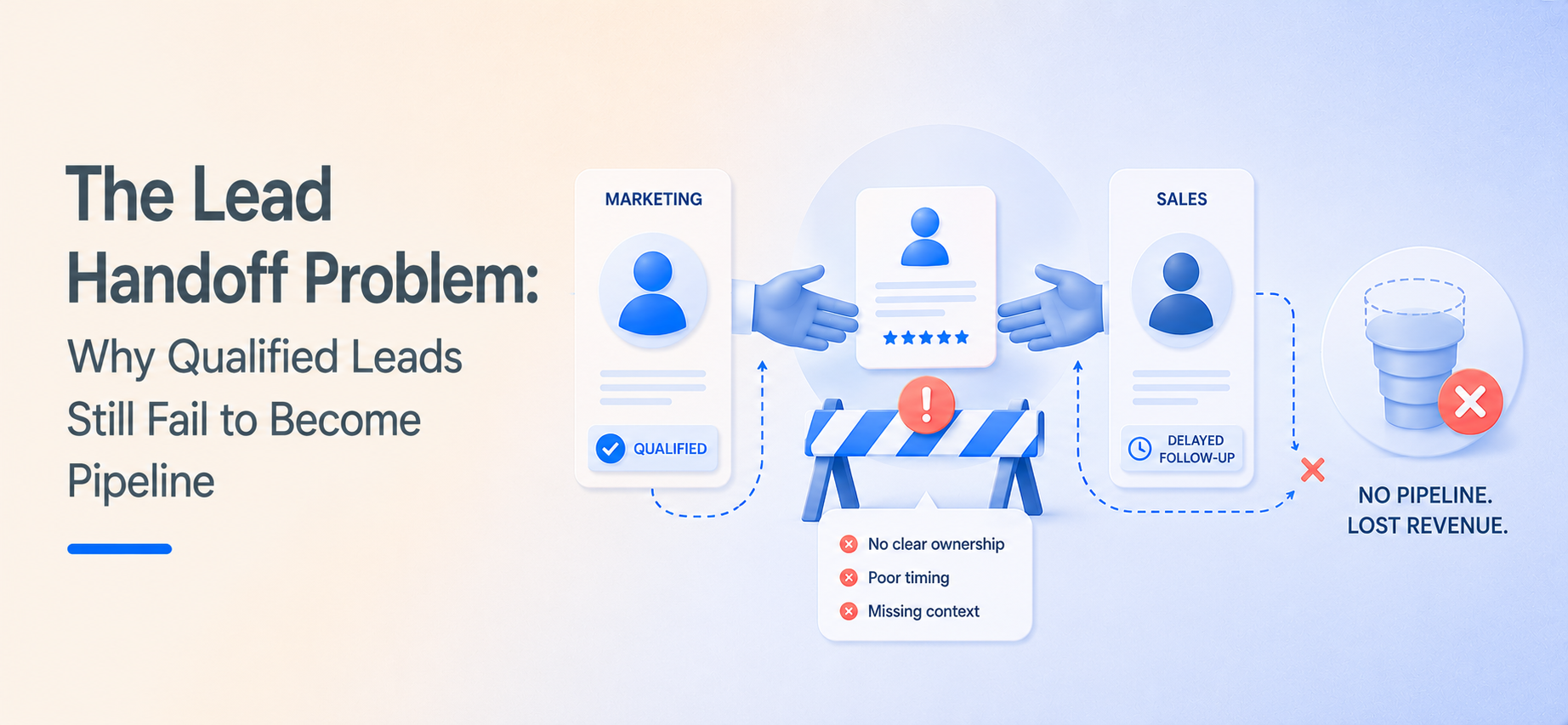
Many B2B marketing teams focus on generating qualified leads, yet pipeline performance still falls short. This article explores why lead handoff failures create revenue leakage, how misalignment between marketing and sales impacts conversion rates, and what demand generation leaders can do to ensure qualified leads become qualified pipeline.
-
Demand Generation
Introduction
Demand generation teams have become increasingly effective at generating leads, improving qualification processes, and delivering prospects that align with target account criteria. Yet many marketing leaders still face a frustrating reality: qualified leads never become qualified pipeline.
The problem often isn't lead generation. It isn't lead quality. It isn't even sales follow-up.
It's the lead handoff.
For many B2B technology companies, the transition between marketing and sales remains one of the largest sources of pipeline leakage. Leads that appear promising on paper stall, disappear, or become trapped in operational limbo. Marketing reports strong campaign performance. Sales reports poor lead quality. Revenue teams miss pipeline targets.
The organizations that consistently outperform their peers have learned that lead handoff is not an administrative process—it's a revenue process.
What Lead Handoff Means for Demand Generation Marketers
Lead handoff is the process of transferring ownership, context, accountability, and next actions from marketing to sales.
Most organizations treat lead handoff as a routing event:
In reality, successful lead handoff involves much more.
Effective handoff answers questions such as:
When those answers are missing, sales representatives often spend valuable time re-qualifying leads instead of advancing opportunities.
For demand generation leaders, lead handoff directly influences:
Common Challenges Marketers Face
Qualification Context Gets Lost
Marketing often collects valuable intelligence during qualification activities, event registrations, partner campaigns, or lead validation processes.
Unfortunately, much of that context never reaches sales.
A lead may be routed with demographic information but without the business challenges, buying initiatives, or engagement history that made the lead valuable in the first place.
Speed Creates Friction
Organizations frequently prioritize lead response speed while neglecting handoff quality.
Fast routing without context creates a new problem:
Sales receives leads quickly but lacks the information needed to have meaningful conversations.
Ownership Becomes Unclear
Many organizations lack formal agreements defining:
This ambiguity creates accountability gaps that directly impact pipeline performance.
Marketing Measures Leads While Sales Measures Revenue
Marketing teams often focus on lead volume.
Sales teams focus on pipeline and closed business.
When handoff processes are weak, both teams evaluate success differently, making alignment increasingly difficult.



.png)

%201.png)


.png)


Solutions That Work
The highest-performing revenue organizations treat lead handoff as a strategic operating discipline rather than a CRM workflow.
Solution #1: Create a Revenue-Ready Handoff Standard
Many companies define lead qualification criteria but never define handoff criteria.
The two are not the same.
A Revenue-Ready Handoff Standard should include:
This ensures sales receives both a lead and a clear understanding of why the lead matters.
Solution #2: Build Context Into Every Transfer
The most successful sales conversations occur when representatives begin with insight rather than discovery.
Organizations should focus on transferring:
When context accompanies the lead, sales can immediately begin advancing opportunities.
Solution #3: Establish Shared Acceptance Criteria
One of the most overlooked lead handoff improvements is creating formal acceptance standards.
Marketing and sales should jointly define:
This removes subjective interpretations of lead quality and creates accountability across teams.
Solution #4: Measure Handoff Effectiveness
Most companies measure:
Few measure handoff performance itself.
Key handoff metrics include:
These metrics often reveal hidden pipeline bottlenecks.
The Revenue Handoff Framework™
Organizations looking to improve handoff performance can evaluate their processes using four key dimensions:
1. Qualification Clarity
Does sales understand why the lead was qualified?
2. Context Transfer
Is critical buying information transferred effectively?
3. Accountability Alignment
Do both teams agree on ownership and expectations?
4. Conversion Visibility
Can leadership measure handoff effectiveness?
Organizations that score highly across all four dimensions typically experience stronger pipeline conversion and better sales-marketing alignment.
Where Site Ascend Fits
While strategic improvements must come first, execution often becomes the limiting factor.
Site Ascend helps organizations operationalize stronger handoff processes through:
Rather than simply generating activity, Site Ascend helps organizations create more structured transitions from engagement to sales conversation.
Actionable Steps for Marketers
Lead Handoff Readiness Assessment
Evaluate your current process using the following questions:
Process
Data
Performance
Alignment
If multiple answers are "no," your lead handoff process may be creating hidden pipeline leakage.
Comparison of Market Solutions
Organizations typically address lead handoff challenges through several approaches.
Internal Teams
Internal teams often provide the strongest organizational knowledge but may struggle with scalability, process consistency, and resource constraints.
Technology Platforms
Platforms improve workflow automation and visibility but cannot solve qualification quality or organizational alignment issues on their own.
Traditional Outsourced Providers
Many providers focus on lead volume and appointment activity but may provide limited qualification depth or executive-level engagement.
Performance-Based Providers
Performance-based models create stronger alignment around outcomes and often emphasize meeting quality over activity metrics.
For organizations focused on executive engagement, qualification rigor, reporting visibility, and measurable outcomes, providers that combine operational discipline with performance accountability often deliver the strongest results.
Conclusion
Lead handoff remains one of the most overlooked contributors to pipeline performance.
Marketing teams can generate highly qualified leads, implement sophisticated qualification processes, and drive strong campaign engagement. But if critical information is lost during the transition to sales, pipeline creation suffers.
The organizations generating the strongest revenue outcomes treat lead handoff as a strategic capability. They establish clear ownership, transfer meaningful context, align qualification standards, and measure handoff performance as rigorously as they measure lead generation.
If your team is looking to improve lead qualification, executive engagement, channel marketing outcomes, or event-driven pipeline creation, Site Ascend can help operationalize the processes that turn qualified leads into qualified pipeline.
How is lead handoff different from lead routing?

What is the biggest lead handoff mistake organizations make?
How should marketers measure lead handoff success?


Start your pilot campaign today and explore the full range of Site Ascend's demand generation capabilities. Experience firsthand how we can enhance your efficiency, streamline your processes, and drive growth.
RELATED