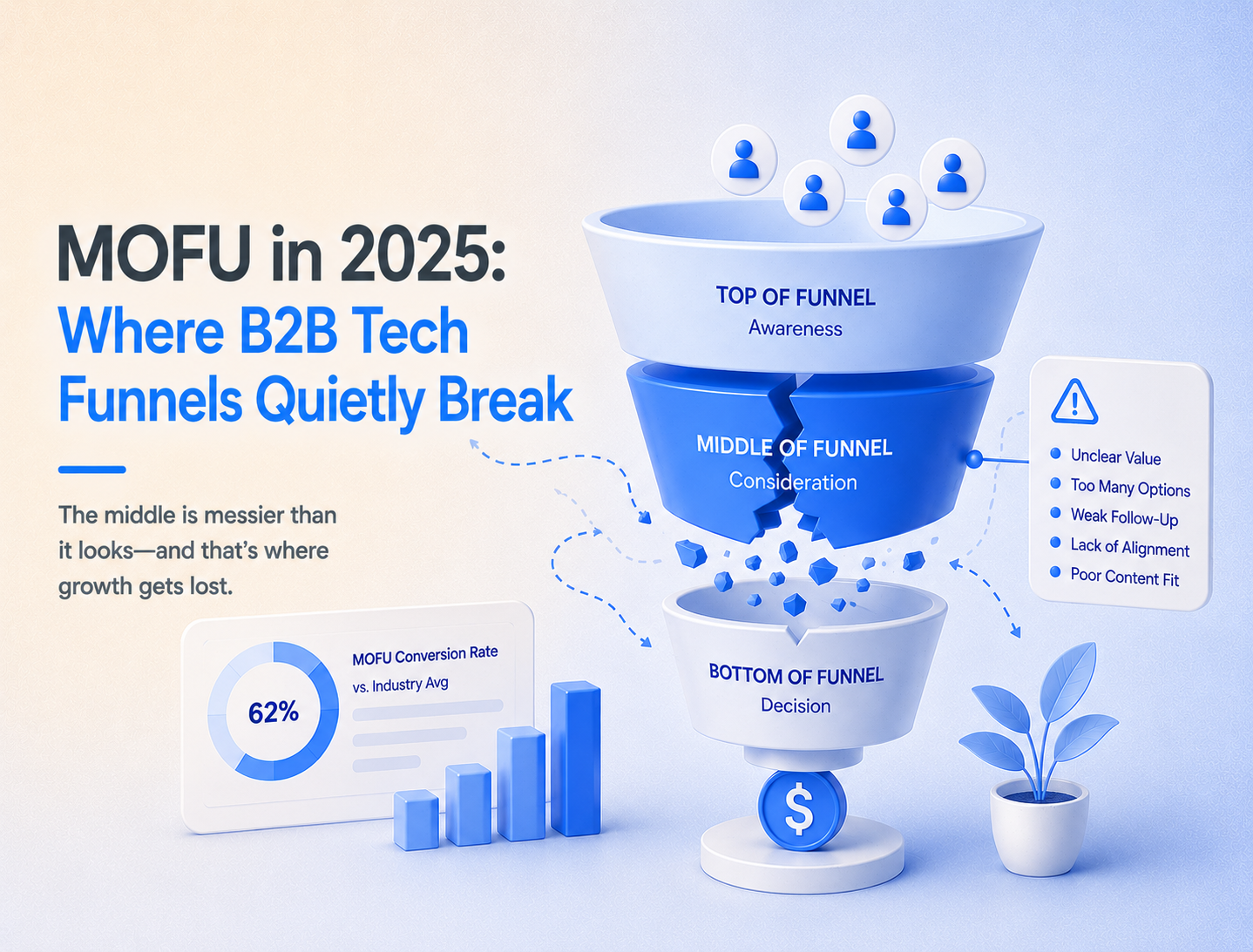
MOFU in 2025: Where B2B Tech Funnels Quietly Break
Demand Generation


MOFU performance isn’t proven by opens, clicks, or “engaged” status—it’s proven when Sales shows up to a meeting that actually happens. This post breaks down the handoff mechanics that turn mid-funnel interest into booked, confirmed conversations, including how to qualify opt-ins, prevent lead leakage, and use pay-for-performance meeting programs to reduce risk and increase sales acceptance.
-
Middle-of-Funnel (MOFU) Conversion & Lead Qualification
Introduction
Most demand gen teams don’t have a MOFU problem. They have a handoff problem.
The signals are there: webinar attendance, product page revisits, partner referrals, opt-in downloads, demo requests that stall, and “engaged” accounts that light up dashboards. But Sales still says the same thing: “These aren’t meetings.”
That disconnect is not a semantic debate—it’s a revenue risk. If your middle-of-funnel motion doesn’t reliably convert interest into confirmed, attended conversations, then MOFU becomes a holding pen where time decays intent and SDR time gets burned on follow-up that doesn’t stick.
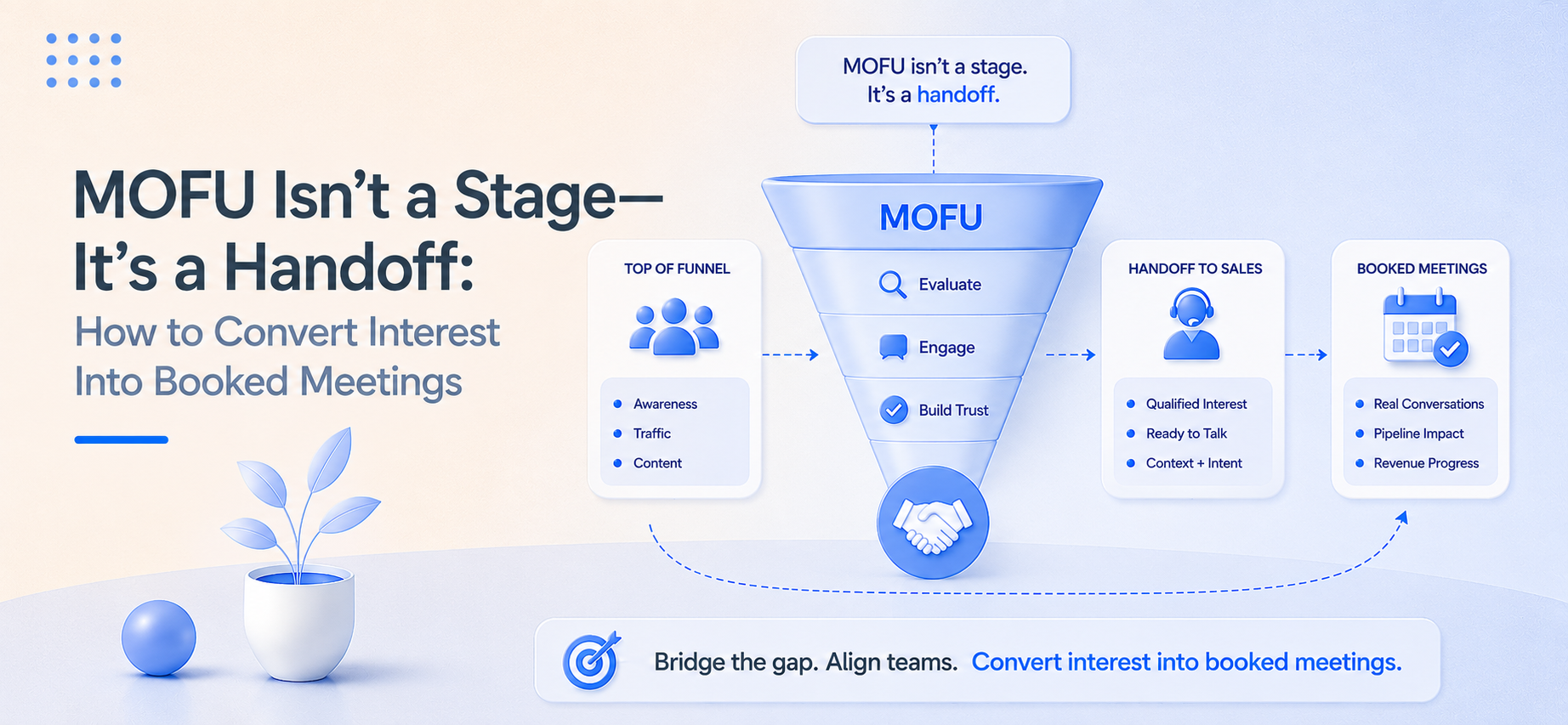
This post reframes MOFU as what it really is in enterprise demand gen: a conversion handoff from “interested” to “next step Sales accepts.” And it outlines a practical, pay-for-performance approach to turning mid-funnel signals into booked meetings that actually happen—without inflating your team, adding offshore risk, or asking Sales to chase ghosts.
What MOFU Means for Demand Generation Marketers (When You’re Accountable for Pipeline)
MOFU (middle-of-funnel) is often treated like a set of assets and programs—nurtures, webinars, mid-stage content, partner motions, retargeting. In practice, for enterprise teams, MOFU is the moment your pipeline risk becomes visible.
Here’s a more operational definition:
MOFU is the point where marketing owns the conversion standard—the criteria and process that turns activity into a Sales-accepted next step.
In other words, MOFU is not “engagement.” It’s readiness plus logistics:
If either side fails, you’re not running MOFU—you’re running a reporting layer on top of lead decay.
That’s why teams that win in MOFU obsess over a few unglamorous questions:
This is where Site Ascend’s model shows up differently: we focus on director-level-and-above conversations and you only pay for meetings that occur, with a U.S.-based contact center, real-time reporting, and white-labeled outreach when needed. That forces the MOFU conversation out of “volume” and into “outcomes.”
Common Challenges Marketers Face in MOFU Handoffs
1) “Engaged” doesn’t mean “available”
A prospect can be very interested and still not take a meeting. Enterprise calendars, internal politics, and prioritization kill conversion. Most MOFU programs measure engagement and assume availability follows.
It doesn’t.
2) Sales acceptance breaks when criteria are vague
If your definition of “qualified” is fuzzy, every handoff becomes a negotiation. Sales rejects leads. Marketing argues the scoring. SDRs get stuck relitigating intent instead of creating pipeline.
MOFU collapses when “qualified” means “they clicked.”
3) The follow-up window is too slow for enterprise reality
Mid-funnel leads don’t necessarily go cold because they weren’t interested. They go cold because they weren’t contacted correctly, quickly, and persistently enough to land a conversation while the topic was still active.
4) SDR time gets burned on low-probability work
When the conversion mechanism isn’t predictable, SDRs become the catch-all. They’re asked to chase inbound, partner leads, event leads, and recycled leads—often with incomplete context and shifting prioritization.
That’s not pipeline acceleration. That’s pipeline friction.
5) No-shows quietly erase ROI
A booked meeting that doesn’t occur is a hidden tax on your funnel. It wastes Sales time, erodes confidence in marketing-sourced meetings, and skews your reporting because “meeting set” is not the metric that matters.
MOFU only works when attendance is treated as part of qualification.



.png)

%201.png)


.png)


Solutions That Work
The strongest MOFU handoffs are built on a simple principle:
Treat a meeting like a product with a spec—not an outcome you hope happens.
Below is a practical framework used by teams that consistently convert interest into Sales-accepted conversations, and how Site Ascend supports it.
1) Define a “Sales-Accepted Meeting” standard (not a lead standard)
A Sales-Accepted Meeting standard typically includes:
This eliminates the most common failure mode: marketing optimizing for lead production while Sales optimizes for pipeline probability.
Site Ascend is structurally aligned here because our programs are built around director+ meetings and only pay for meetings that occur—so qualification and attendance are not optional.
2) Use outbound dialing to convert signals into conversations (not more automation)
MOFU is where most teams over-rotate into digital “touches” and under-invest in direct conversion.
For enterprise, the conversion moment usually requires a human interaction:
Site Ascend operationalizes this through outbound dialing to reach the right stakeholder and secure the meeting, paired with a structured SMS workflow that supports confirmation through the meeting date. This is especially effective for:
3) Make attendance a first-class KPI
If you don’t manage attendance, you don’t manage MOFU.
Treat meeting integrity like a funnel stage:
This is where many vendors and in-house motions fall short: they optimize for “set rate,” not “held rate.” Site Ascend’s pay-for-performance approach forces rigor because the output is “meetings that occur,” not “meetings scheduled.”
4) Build a clean ownership model for handoffs (especially for channel and events)
MOFU is where channel conflict shows up: partner leads, co-marketed events, routed accounts, unclear rules of engagement.
A clean ownership model includes:
Site Ascend supports this through white-labeled outreach (when partner optics matter), real-time reporting, and conversion workflows that can be configured around your SLAs and routing rules.
5) Reduce risk with pay-for-performance meeting programs
If your MOFU programs are producing meetings with unpredictable quality and attendance, you carry all the risk:
A pay-for-performance model shifts that risk toward the meeting provider. With Site Ascend, you only pay for meetings that occur, supported by a U.S.-based contact center and a focus on director-level and above stakeholders. That’s not just a pricing model—it’s an operating model that forces discipline.
Actionable Steps for Marketers
Use this checklist to tighten your MOFU handoff within the next two weeks—without changing your entire tech stack.
The MOFU Handoff Checklist (Practical and Implementable)
1) Write your Meeting Spec (one page)
2) Set a follow-up SLA measured in hours, not days
3) Add a confirmation layer
4) Create a reroute path when Sales is slow
5) Decide where you want to “buy certainty”
Comparison of Market Solutions
Below is a practical way to evaluate MOFU conversion options using a procurement-style lens—focused on outcomes, operational risk, and organizational fit.
Example 1: The Procurement View
Outcome 1: Meeting Quality (director+ relevance and acceptance)
Outcome 2: Meeting Integrity (attendance and no-show reduction)
Outcome 3: Operational Risk (cost predictability, brand control, reporting)
Conclusion
MOFU doesn’t fail because your content is weak or your scoring model is imperfect. It fails when your conversion handoff isn’t engineered to produce a Sales-accepted next step—consistently, with the right stakeholders, and with meetings that actually occur.
If your team is sitting on plenty of mid-funnel activity but struggling to convert it into dependable conversations, the fix is rarely “more nurture.” The fix is a tighter handoff standard, a direct conversion motion, and an operating model that treats attendance as part of qualification.
If you want to reduce lead risk and turn MOFU signals into meetings your Sales team will show up for, Site Ascend can support a pilot built around pay-for-performance outcomes—so you only pay for meetings that occur.
What’s the difference between an MQL and a Sales-accepted meeting?

How do you prevent MOFU handoffs from creating friction with SDR and Sales teams?
When should a team use a pay-for-performance meetings partner instead of building in-house?


Start your pilot campaign today and explore the full range of Site Ascend's demand generation capabilities. Experience firsthand how we can enhance your efficiency, streamline your processes, and drive growth.
RELATED